skip to main |
skip to sidebar
 Most people might debate over what exactly is the greatest aspect of a film like The Day the Earth Stood Still. It could be the solid acting performances of Patricia Neal and Michael Rennie. It could be the fear-inspiring qualities of the robot Gort. Or it could be the collective sentiments that the movie evoked upon its initial release to the world, which was at the time mired in Cold War angst and xenophobia.
But no, the greatest trait of this cinematic gem is the fact that it is as utterly mesmerizing a film in 2008 as it was 57 years ago, in 1951. Sure, its context may have changed but its overall campaign for peace and understanding resonates as loud as ever. It's a message the human race still has yet to learn, and one that hits even harder upon that realization.
We could all use the sort of rude awakening Klaatu (Rennie) and Gort (Lock Martin - truly more machine than man) bring to Earth. Imagine all of the electricity on the planet going out, for a half hour. It would be even more catastrophic in today's technology-driven world than it was then.
But at the same time, Rennie brings an odd sort of comforting presence to Klaatu. He's an alien bringing a warning of destruction to the planet, yet he makes you feel so at ease through it all. He takes young Bobby Benson (Billy Gray) sightseeing throughout DC and solves seemingly unsolvable equations for the eccentric Professor Barnhardt (Sam Jaffe), and is equally convincing in each facet of his Earth persona, Mr. Carpenter.
What's more, his performance brings out the best in his co-stars, making them more believable and, thus, the film more likable. All things considered, Patricia Neal on her own is rather uninspiring as Helen Benson, but she has a certain chemistry with Rennie that allows you to overlook it all.
Given the upcoming remake, it might be easy to overlook the artistic side of things. How can a film from the 50s possibly compete with 21st-century blockbuster? In much the same way that the 1933 version of King Kong trumps Peter Jackson's recent remake: the effects are there to augment the film, not to drive it. By not assaulting our senses with cheese, director Robert Wise lets us truly appreciate his special effects for the time period from whence they came - whether the spaceship travelling to Earth or Gort's creepy eye-beams that melt anything he chooses.
I could go on, but I'd likely be here for weeks listing all of the positives. Put simply, The Day the Earth Stood Still is a sci-fi classic and an indisputably great piece of filmmaking - as relevant today as it was half a century ago. But don't take my word for it. Rent this, and let the movie do the talking...
4 stars out of 4
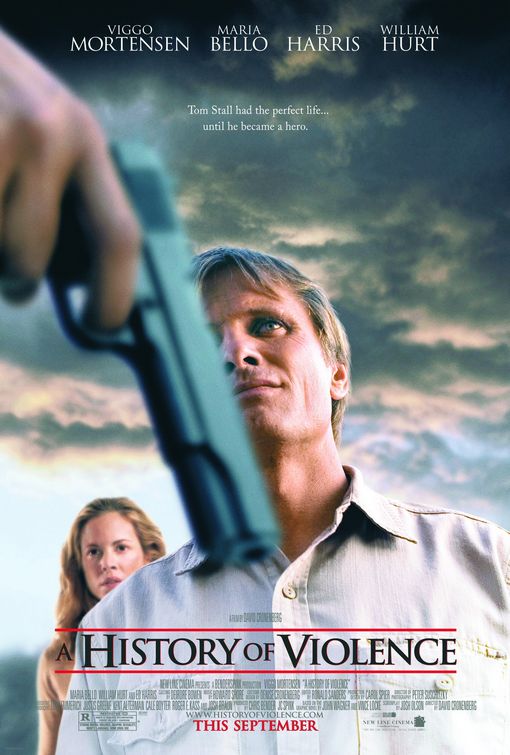
 Split-personality characters rarely come as mysterious as Viggo Mortensen's in A History of Violence.
On one side, he's Tom Stall - married with two kids, the mild-mannered owner of a diner in small-town Indiana. People in his town know him because, well, everyone knows everyone. Until, that is, he kills a couple of criminals one night in his diner in self-defense. Then people know him for being a hero.
And it's then that his other side comes out. The news of his actions travels fast, and before long, Tom's being stalked by a creepy mobster from Philadelphia (Ed Harris) who believes him to be one of his crew and, in fact, called Joey Cusack. Another mobster. A violent one. A killer.
It's a credit to director David Cronenberg that A History of Violence doesn't reveal anything too soon. But unfortunately what ends up being the film's biggest downfall is that there are some things it doesn't reveal at all. So in the end, the Cronenberg-Viggo pairing IS, once again, a success. Just not as big as the duo's next excursion, Eastern Promises.
However, the movie's good enough for the most part to keep us interested in spite of these shortcomings. In addition to the mystery behind Stall/Cusask (which one is he?), the movie's true gusto as a thriller comes from the manner in which Tom's conflict comes to affect his family. We're left not just worrying for his safety and outcome, but for theirs as well. We see it strike his wife, Edie (Maria Bello), whose paranoia turns to fear and again into anger over her husband's predicament. But it comes through strongest in his son, Jack (Ashton Holmes), who transforms from a mild-mannered high school loser to a vicious fighter as the movie progresses.
Unfortunately, the plot holes prove too many to overcome, particularly toward the end of things. There are also some miscasting issues, namely Bello - who should really just retire from cinema altogether. But if Bello's performance is of her typical, unsympathetic self, then there is another miscasting in A History of Violence that is truly deplorable - William Hurt as another Philly mobster, unconvincing and overhammed, apparently, enough to receive an Academy Award nod.
All in all, not bad. Cronenberg and Co. have whipped up a crafty, satisfying thriller that should wind up entertaining all. But if we consider his pairings with Mortensen as we would a sex life (not entirely inappropriate, considering their next film), A History of Violence is kind of like that all-important "first time" - something to talk about, something to remember, but ultimately not as good as what's to come.
3 stars out of 4
 On September 11, 1971 - an interesting date, if you think about it - London experienced one of the single biggest robberies in its history. It saw nearly £3 million in cash and goods stolen from a Lloyds Bank branch at the corner of Baker Street and Marlyebone Road in a heist that (appropriately) became known as the Baker Street robbery. Of the thieves or the aftermath little of substance is known, but the two have become widely speculated urban legends ever since.
Which brings us to 2008, and the Hollywood retelling of these events, The Bank Job. The producers took full advantage of the fact that so little is known about the robbery, turning the movie essentially into a 1970s British version of Ocean's Eleven. But instead of being overwhelmed by celebrity (ultimately the downfall of the Ocean's franchise), we end up being enthralled by what's important - the story and its presentation on screen.
Jason Statham shines as head robber Terry Leather in a rare role that doesn't waste his charisma. For every decent film Statham makes, he usually follows up with two or three abysmal ones. (So following The Bank Job...well, let's worry about that when it happens...) Here, he excels as the leader of the group, exuding a certain air of confidence even in the most precarious of situation. It's his handling of things above all that keeps our eyes glued to the screen.
It's hard to tell where reality stops and imagination begins in The Bank Job, but here's the general idea of things: an old fling of Leather's named Martine (Saffron Burrows) presents him the opportunity for the robbery. Terry's had his share of mischief, but this job represents a chance for he and his friends to take the next step and make out big. They take it.
But, as has become incredibly predictable in these sort of films, the crew gets more than they bargained for. Tension from all directions mounts, from the love triangle of Terry, Martine and Terry's wife Wendy (Keeley Hawes) to the continuing struggle against aptly named political activist Michael X (Peter de Jersey). Add in police corruption and a veteran London porn king, and you get a movie whose plot you can never really figure out until the end. Not a bad quality to have in a movie, though, is it?
The biggest success of the film is the crew, with each character as endearing and believable as the next. The lone exception is Burrows, whose importance to the film is undermined by a dry, unsympathetic performance. But then, she's not really part of the team anyway. Oops, did I just give something away?
Oh well, it's a minor detail in a movie with thousands. For all it's Hollywood-ing, The Bank Job is as good a heist movie as there's been in at least 20 years, if not ever. So kick back, grab your popcorn, and get ready to be entertained.
3 stars out of 4
 Captivating, heart-wrenching stories aren't often found among video gamers, and even less so in documentaries about video gamers. But apparently Seth Gordon missed that memo. In his documentary The King of Kong: A Fistful of Quarters, he pulls one off - presenting the saga of one Steve Wiebe and Billy Mitchell.
Mitchell's the old master, holding high-score records in five classic arcade games and even gracing his own trading card. (You think I'm joking, but watch the movie; by the end, such a statement doesn't seem remotely far-fetched.) For years, his score of 874,300 points in Donkey Kong was a world record.
Until, that is, Wiebe came along, submitting a videotaped score of more than one million points to video game records keeper Twin Galaxies. But because of the many rules and technicalities in competitive gaming, his score is scrutinized and eventually dismissed altogether. Determined to prove his legitimacy, Wiebe crosses the country to popular east-coast arcades to establish himself.
What follows is an escalation of Mitchell and Wiebe's competition into what video game referee Walter Day calls "one of the great rivalries of all time." (You really can't make this stuff up.)
There's Mitchell - the New York Yankees of the two - and his ascent from teenage gaming prodigy to one of the world's most popular gamers. He's one of those perpetually lucky people who seems to win at everything, from gaming to the running of the popular Rickey's World Famous Restaurant chain. Then there's Wiebe, who's more like the Red Sox were for all those years before breaking their "curse." A middle school science teacher, Wiebe's life is chock full of ups and downs (mostly downs, from his high school baseball career being cut short to his firing from Boeing).
But we also see Gordon pull off a rare trick. He gives us something that transcends being a mere "documentary" and merits judgement as a true "movie." The film runs the emotional gamut, giving us comedy with heartbreak and happiness alongside anger. In short, it informs us, but it also entertains us in a way that eludes far too many modern movies - by completely enveloping its viewers.
We see Wiebe emerge as the dominant persona, and watch our emotional highs and lows mirror his own. As he sheds a tear over the unfortunate ending of his quest, we nearly do the same. We also see Mitchell become less and less likable as the story unfolds, at first inspiring feelings of uneasiness which gradually progresses into anger and resentment.
Launch into arguments about what this movie's appeal says about our society if you wish. I did. But then, allow yourself to sit down and watch it with an open mind. With any luck, by the time the credits roll, it will have opened your eyes as well.
3 stars out of 4
Contrary to what some of you may believe, I did, in fact, survive my fall semester at SU and am now bored out of my effing mind less than 12 hours into my break. Consequently, Ahh, Cinema...will hereby be re-enacted for the duration of my winter break, to keep me sane and my writing sharp. Look for my first review in almost four months a bit later tonight.
Cheers,
-Dan
 When people mention that Tropic Thunder is a satire of all things Hollywood - overzealous actors, greedy and disconnected executives and the perversion of the creative process - you might not initially realize how far they've taken it. The movie is a commentary on the familiar faces in the industry - the moguls and the mega-stars, but it is also one of its fans, its critics, its techniques, its very MO.
Take, for example, the opening of the movie. Before we see even a frame of the movie-within-a-movie, we're treated to an attack on the commercialism of Tinseltown, through fake ads (a sports drink called "Booty Sweat," and its accompanying "Bust-A-Nut" bar) and, eventually, movie trailers. There's the sixth installment of action star Tugg Speedman's (Ben Stiller) "Scorcher" franchise, followed only by Jeff Portnoy (Jack Black) doing his best Eddie Murphy imitation in "The Fatties: Fart Two." And to close it out, we get the art house drama "Satan's Alley," a kind of medieval Brokeback-esque romance between two monks (Tobey Maguire, and Robert Downey Jr.'s on-screen ego, Kirk Lazarus).
Stiller, who directed and co-wrote with Justin Theroux and Etan Cohen, is no stranger to comedy. His parents - Jerry Stiller and Anne Meara - made up one of the enduring comedy duos of the 1960's, so it's basically in his blood. His last venture into directing was 2001's Zoolander - a wildly hilarious satire of the vanity and ignorance of the modeling industry. Yet deservedly or not, most people would probably point to Stiller's comedically-flawed characters as the apex of his talent.
And we see a little bit of all of them here in his newest role, action star Tugg Speedman. Speedman's a Stallone type hero, who, in dealing with his decreasing relevance in Hollywood, sort of reminds us of Stiller's past lovable loser roles in Meet the Parents or There's Something About Mary. But as he leads the team of actor-soldiers on the set of the war flick, there are flashes of his gung-ho, strictly business types, as in Dodgeball's White Goodman.
But after a failed attempt at serious drama playing a mentally retarded farmhand named Simple Jack, his next role is very much a make-or-break performance for Speedman. So for this adaptation of a Vietnam vet's memoir, he teams up with the comedian Portnoy and the award-winner Lazarus, who's had his skin darkened so as to play the platoon's African-American Sgt. Osiris. (Before anyone says anything, it's not a knock on African-Americans; it's a knock on the actors who think their talent and range are limitless.) Hot new rapper Alpa Chino (say it out loud) and relative newcomer Kevin Sandusky (Or is it Kyle? They never seem to know) round out the troop. And almost before anything happens, there's already trouble.
Struggling with a rookie director (Steve Coogan) and numerous financial catastrophes in the shooting, the film is finds itself a month behind schedule only five days in, and the studio executives (Bill Hader and a surprisingly funny Tom Cruise) aren't happy. And the stars couldn't appear to care less; they're too preoccupied with the setup of their on-location TiVo systems or the occasional call from an agent (the scene-stealing Matthew McConaughey).
So the Vietnam vet (Nick Nolte, looking not entirely unlike his recent mugshot) proposes that the filming be moved deep into the jungle and shot guerrilla-style, and it's here that Tropic Thunder takes on a new direction. It's not as much a movie about the making of a war-movie anymore; once they're thrust into the wild, attacked and captured by drug lords, you know it's become strictly a war-movie on its own. The trouble is that now we're dealing with two brands of humor that don't exactly level up with each other.
On one side, there's the occasional dip back into Hollywood-land and all its side-splitting hysteria, as the studios react to their stars' abductions. This is the kind of humor you wish the entire flick was made of, as executives mistake ransom phone-calls for agency negotiations and big-headed stars utter lines like "I don't read the script; the script reads me."
But unfortunately, this is often buried beneath a feeble attempt at action-comedy. Here, they'll try just about anything to make us laugh - from stereotype jokes (a "you people" interaction, along with a hilarious new entry to the moviegoer's vocabulary - "full retard") to obscenity-laced rants in drug deprivation. Sometimes they work, but more often than not (excuse the pun), they misfire - meriting little more than forced giggles that pale in comparison to the earlier belly laughs.
And it's this unevenness that ultimately drags a promising movie down. As the film comes from its brief moments of brilliance to be dominated by the stupider bits, we find ourselves too often on the fringe - unsure of whether we really like the movie or not. Mere instinct suggests that it might someday be a grower, but for now, it's just OK. War is hell, indeed.
2 stars out of 4
 A man awakens from an immeasurable sleep to find himself in a hospital room. His blurry vision slowly outlines two figures, which become a throng of people surrounding him and trying to communicate. He feels normal, if not slightly incapacitated from his slumber. But as he tries and fails to communicate with those around him and his medical state slowly becomes apparent, we discover he's anything but. "Normal," has become a thing of the past; this man's life will never be the same.
Such was the case for French journalist Jean-Dominique Bauby. Following a massive stroke in December 1995, the former Elle magazine editor awoke to discover he'd developed "Locked-In" syndrome, leaving him awake and entirely aware of his surroundings but deprived of motion or speech due to near complete paralysis. The only part of his body left mobile was his left eyelid. Slightly incapacitated, indeed.
But with that eyelid, Bauby devised a system of communication that allowed him to write his memoir, The Diving Bell and the Butterfly. As a transcriber read off a list of letters, Bauby would blink his eye to choose the right ones, forming words and eventually a chronicle of his life following the stroke. He wove together details of his post-stroke life, from interactions with visitors to simple procedures like bathing, with descriptions of his life before the condition, garnering critical acclaim and numerous best seller honors across Europe.
Ten years after its publication and Bauby's subsequent untimely death, director Julian Schnabel gives us a movie adaptation as beautiful and inspiring as the story and work from which it's adapted. Shot fittingly from a first-person camera perspective, the film attempts quite literally to take us inside Bauby's head following the discovery of his condition. It's a technique that makes us rethink traditional cinema, and it allows us to not merely watch the story unfold, but to live it.
It also, unfortunately, undermines an admirable performance from Frenchman Mathieu Amalric. Though his face-time may be lacking, Amalric shines as a personification of Bauby's remaining active, living qualities. Only Bauby truly knew what was going on inside his head, but thanks to Amalric's performance and a stunning script from Ronald Harwood, the movie delivers the best of both worlds. The audience gets a respectable interpretation of his life on this side of the condition, and Bauby, most importantly, gets a voice.
The voice may just be the most important part of the film, elevating it from simply a great story to an experience we'll never forget. It would have been one thing to just show Bauby's experiences following the stroke. Surely, taking a bath or being sung to would have been entirely more laborious than before, but in all of these cases, Bauby had help. Lacking most functions, he had to share these tasks with his attendants. So as important as they are to the telling of the story, the realization that they've all been lived before by people other than Bauby takes away a bit of the shine.
But nobody's ever seen inside Bauby's head before, which renders the glances inside that much more intriguing. If that renders Schnabel's efforts as quasi-novelties, so be it. Novelties they may be, but they make the film a far more emotionally-rewarding experience. It would have been hard to duplicate the anguish in the interactions between Bauby and his wife (Emmanuelle Seigner) or his father (Max von Sydow, in a touching cameo) without it. Because we know there's someone inside trying but incapable of responding to their desperate pleas, it makes the content nearly as taxing for the audience as for those involved.
Take, for example, an early interaction between Bauby and his aide, Claude (Anne Consigny). Having just devised the basis for their communication system, Bauby strings together a series of letters telling Claude "je veux mourir" - "I want to die." With us essentially inside Bauby's head, the feelings and the message start to feel like they're sprouting from our own, which ultimately lend a new appreciation of the lives and capabilities we all have.
His journey from this moment at rock-bottom to having completed his memoir becomes one from which we cannot look away. While it is a bit difficult to relate to Bauby in his "Locked-In" state, the frequent trips back to his normal past life tie our insides in knots. They remind us that such ailments can happen to anyone, encouraging us on a deeper level to live our lives to the fullest. Bauby may not have before his stroke, but this documentation of his perseverances after show us that he certainly did in later life.
4 stars out of 4