skip to main |
skip to sidebar
 Usually, while watching a movie, one's mind is on just that - the movie. That wasn't the case with Transformers: Revenge of the Fallen. While watching - or rather, while staring (the term "watching" implies a certain degree of active focus, which I'm not sure there was on my part) - I was compiling a mental list. It was a seemingly never-ending list, comprised of every mindless, utterly absurd concept that director Michael Bay presents in the film and, consequently, expects us to go for. I now present an abbreviated version of this list to you (chronologically, to eliminate the need to summarize its "plot"):
Michael Bay expects us to believe that:
- Transformers have been secretly inhabiting Earth since 17000 BC
- Transformers can smell other Transformers.
- Transformers can speak a variety of dialects that includes gangsta, Italian mobster and Scotsman, and use phrases like "punk-ass Decepticon."
- It would be a totally awesome idea to include two characters (the so-called "Twins") who are more racist than Jar Jar Binks, "Amos 'n' Andy" or even Michael Richards.
- Cutting to a scene of two dogs fucking is perfectly acceptable during an action sequence.
- Transformers can cry at the prospect of being left home when Shia LaBoeuf goes to college.
- Shia LaBoeuf can go to college.
- While at college, Shia LaBoeuf can maintain a long distance relationship with Megan Fox while using a web-cam.
- Megan Fox actually knows how to use a web-cam, or a computer for that matter.
- Shia LaBoeuf was ever able to win Megan Fox over in the first place.
- Shia LaBoeuf's room at college, randomly placed, would contain him and three computer hackers.
- Their dorm room can have a Mountain Dew machine in it.
- The presence of a "Bad Boys II" poster in the dorm room (and the subsequent zoom-in close enough for us to see the credit "Directed by Michael Bay") was purely coincidental.
- Anyone would ever own a "Bad Boys II" poster, much less display it.
- College parties play bad remixes of Talking Heads songs, and people actually enjoy them.
- Shia and the three computer hacker roommates would actually be allowed into a college party.
- Shia LaBoeuf's mother in the film isn't mentally retarded.
- Decepticons can pose as humans, and somehow manage to infiltrate a university as bodacious college girls to target Shia LaBoeuf.
- John Turturro posts on websites created by college-age hackers under the alias "RoboWarrior."
- The only job John Turturro could get after being dismissed from Sector 7 was working in a deli for his mother.
- Of all of the thousands of soldiers in the U.S. military, Josh Duhamel and Tyrese Gibson would once again be at the center of the Transformer battle.
- Despite having been fired from Sector 7, John Turturro still has a number of CIA and military numbers at his disposal, including, conveniently, Duhamel and Gibson.
- Turturro could actually convince Duhamel and Gibson to spearhead a military operation in northeast Egypt to rescue Shia LaBoeuf that defies orders from the President - and somehow keep it all a secret.
- The National Air and Space Museum is actually filled with old Decepticons.
- Decepticons can simply defect to the Autobot side.
- Decepticons, despite never having had the misfortune of encountering them in person, can automatically identify Shia LaBoeuf's parents and take them hostage to use as a trap.
- There is a machine that can destroy the sun hidden in one of Egypt's Great Pyramids.
- A group of Transformers destroying said pyramid and the surrounding villages could go virtually unnoticed by any of the world media.
- The key used to activate the machine can also revive a dead Transformer.
- Dead Transformers can be brought back to life.
- The idea of a Transformer humping Megan Fox's leg is utterly hilarious.
- Transformers have testicles.
- Transformers can absorb the parts of other Transformers and heal themselves in a matter of minutes.
- Shia LaBoeuf would actually want to lead the idiots that call themselves his parents to safety during a battle.
- Farm animals wouldn't want to lead themselves to safety during the same battle, despite the presence of soldiers, guns and, oh yeah, Transformers.
- There is a Transformer heaven.
- Shia LaBoeuf, a human, could go to Transformer heaven.
- Shia LaBoeuf can suddenly come back to life when Megan Fox says she loves him, but not after having been twice pumped by a defibrillator.
- Making a third movie in this franchise is a good idea.
The first Transformers film did the unthinkable in lessening (albeit temporarily) my absolute loathing for Bay. Was it a great film? No. The plot was numbing, the dialogue laughable and the explosions were entirely excessive. But underneath it all, there was something about the first film that was at least semi-enjoyable.
But any good will he may have earned from the first movie has not only been pissed away - it's been pissed into a jar, sealed and punted to the bottom of the ocean. To call Revenge of the Fallen a bad movie would be being entirely too generous. It's too long, too loud and too clichéd in almost every aspect. It has an absolutely abysmal script and displays an overall level of incompetence that makes Heidi and Spencer seem like Rhodes scholars. There is not a single respectable filmmaking step taken throughout the entire 140-something minutes, while virtually every lamentable technique makes its way to the screen.
For example, look at the film's title: Revenge of the Fallen. Let's think of some possible questions you might ask going in. Who (or what) are the Fallen? What are they getting revenge for? And who are they getting revenge against?
So we sit back and watch, waiting for an explanation. More than an hour later, we still don't have any answers. And when we find out, we realize that it all has something to do with a brief ice age sequence Bay serves up at the beginning of the movie. It turns out the Fallen is just ONE Transformer, and he started a civil war between the Autobots and the Decepticons 17,000 years ago - during that same ice age. You start to wonder why Bay and writers Alex Kurtzman and Roberto Orci didn't give us any insight into this at the beginning, and then it hits you: had they done that, there wouldn't have been enough time to add another explosion or 5,000 into the mix. Or, more specifically, for Bay to be Bay.
What is Bay being Bay? More than just a KABOOM-tracker, this underlying technique manifests itself in a variety of different guises. In one form, he'll present an idea that's actually sort of interesting (like Decepticons that can disguise themselves as humans) and then abandon it altogether in favor of pushing ahead with several less-interesting concepts. In another incarnation, he'll dumb down the idea of comic relief to the point at which it becomes completely intolerable (for example, look at LaBoeuf's mother, who might be the single least amusing role in movie history). In another, it's giving Orci and Kurtzman the go-ahead on virtually any inane idea they put to paper - whether it's the introduction of the Twins or the idea to actually allow one of them to survive after nearly being eaten by the giant Transformer that almost looks ripped off from Cloverfield. Although, frankly, I'm pretty sure Bay could find some sort of distorted potential if the duo presented him a story about a talking puddle of vomit, as long as it contained the requisite number of explosions.
And what's really sad about all this is that, in watching the film, or attempting to, you get the idea that Bay's actually enjoying himself. Through all of this inanity, he clearly thinks he's made a good movie. You can tell because the formula hasn't changed a bit from the beginning of his career until now. From Pearl Harbor, to Bad Boys II to The Island and now, with Revenge of the Fallen, Michael Bay's modus operandi has waged this war on respectable entertainment. The more he enjoys his movies, the worse they get.
I'll ask you now to step back and think for a second. Think of something really, unbearably annoying - not horrible, but enough to drive you crazy if exposed to it for enough time. NASCAR racing, chalk scratching on a blackboard, Jon & Kate gossip, or maybe a neighbor mowing his lawn at 8 a.m. on a Sunday morning. You get the idea...
Now take all of the ideas you came up with and mash them together, and subject yourself to this new horror. Excruciating? Yes. Painful? Maybe. But no matter what you came up with, it's still better than sitting through this heaping pile of garbage. Worst film of the decade? More like one of the worst films ever made. You can quote me on it.
 Oddly enough, one of the first things you consider while watching The Great Escape has nothing to do with the movie itself. It's most likely because there are so few flaws in the film, but as it unfolds, you actually start think of other overblown, less successful war movies. We all know these - the ones that rely on their subject matter alone for their acclaim, instead of actual filmmaking merit. In many cases, they're successful films, but nowhere near as good as the masses claim. The Great Escape outshines them all for two primary reasons:
First, it doesn't take itself too seriously. Yes, there's a story, and yes, it's based on actual events, but neither the cast nor the crew felt the need to over-dramatize anything. We see the prisoners working feverishly to accomplish their tasks, suffering setbacks along the way, but we also see our fair share of comic relief to make it all more relatable. It's a war movie, but it's also great fun - which sets it apart from most of its other genre counterparts.
Secondly, as an ensemble piece, it treats war as it's meant to be treated - a team affair, rather than a chance for stars to shine. Though Steve McQueen gets top billing as Virgil Hilts, he doesn't factor into the story any more than James Garner, or Richard Attenborough do in their roles. Director John Sturges gives us a group of successful performances in not very demanding roles. It's one of the film's biggest successes, and it mirrors the workmanlike nature of the story. (If any one of them can be called a "star" here, it's Charles Bronson as claustrophobic tunnel king Danny Velinski.)
Don't be put off by the nearly-three-hour run time; The Great Escape will fly right by. It's one of the best war movies you'll ever see, and certainly a film that demands repeat viewing.
3 stars out of 4
 There are three things you need to know about Star Trek - it's big, it's exciting and, most importantly, it's a lot of fun. Let's face it, it's the first enjoyable summer popcorn flick of 2009 (sorry, Wolverine). More importantly, it successfully reboots a long stagnant franchise for a new generation (pardon the pun). You have to ask: could anyone have engineered this rebirth as successfully as J.J. Abrams? For nearly all of its 43-year existence - all ten previous films and seven TV series - the franchise was largely a subcultural (read: nerd-based) phenomenon. Under Abrams (Lost, Mission: Impossible III), this film goes where no Star Trek has gone before: the realm of pop-culture cool.
To start, the film looks amazing. The visuals are nothing short of breathtaking; be it the jellyfish-esque space ship of Romulan villain Nero (Eric Bana) or the sequences of destruction he wreaks upon planet Vulcan, one thing is clear: the effects have finally caught up with us from the 1970s. Another point of success is the acting. Abrams's team of mostly lesser-knowns turns in a group of effective performances in not particularly demanding roles. Kudos to Chris Pine (Kirk), Zachary Quinto (Spock) and Simon Pegg (Quinto) in particular.
Unfortunately, the film's problems lie in its script. The story stumbles at times, and is rife with sci-fi clichés. Given the "origins" nature of the film, one can forgive writers Roberto Orci and Alex Kurtzman, though their previous work on Transformers may make one wary of any future involvement here. However, in watching, you get the impression that sequels will only improve the franchise. Star Trek is still an enjoyable film and a really exhilarating experience. Give it a better script next time around, and we can be sure Abrams' vision will, in fact, live long and prosper.
2.5 stars out of 4
Hey all!
Just gotten back from school for the summer, and you know what that means: Ahh, Cinema... is back up and running!
However, I'll be writing in a different format for my reviews. Everything will be shorter - 2 or 3 paragraphs. I'm cutting plot summary, because a lot of the movies are older movies anyway and summarizing the plot of a 30-year-old movie everyone's already seen (like The Godfather) just seems a bit pointless. Apologies for the new movies, but this format is going to be universal as far as this blog is concerned. Though that might change; we'll see.
Anyway, look for my first review of the summer in a little while. Hope you'll keep up!
-Dan
 In some ways, people will already have seen The Curious Case of Benjamin Button before the film even begins rolling. We have a protagonist misunderstood for his differences which, along with a diverse ensemble of characters, help shape his life, and a struggle with love for "the one that got away." Sound familiar? Sounds a bit like 1994's Forrest Gump to me.It comes as little surprise, since screenwriter Eric Roth penned both scripts. But his efforts with Button yield more satisfying results. Why?
Having David Fincher direct certainly doesn't hurt. But this time around, Roth re-worked previously-written material, in this instance a lesser-known short story by F. Scott Fitzgerald. The original Benjamin Button wasn't so much a story as it was a labor, a disappointingly sardonic look at a truly interesting concept - being born old and growing younger with the passage of time.
Here, the recycled elements of Gump have helped create an adaptation that surpasses its original inspiration. Every character is vital to the protagonist's life, resulting in a story that becomes less a chore than a joy to soak up. The film affords each star its shining moment, (even Cate Blanchett!) and makes the story's three-hour run time breeze right by.
Perhaps the biggest reason for that is one of the film's strongest aspects (and the first we notice), its artistic merit. Benjamin Button is one of the most visually stunning movies you'll ever see. We all know going in of the monumental task it faced in presenting the wonders of aging (or is it timelessness?), and they've succeeded resoundingly in that respect. But even more impressive is the scene construction; each one as vivid and beautiful as the last. You're not just watching for three hours, but experiencing this story.
Few scenes achieve the same visual quality as the opener, the night of Benjamin's (Brad Pitt) birth in 1918. Born on the night World War I ends, Benjamin's aforementioned condition sees him promptly abandoned by his father (his mother dies in childbirth) and left with nursing home attendant Queenie (Taraji P. Henson). His early life sees a myriad of different encounters - from a ship captain who gives him his first real job to a resident of the nursing home whose sole purpose seems to be for comic relief, discussing the seven times he's been struck by lightning.
But despite their varying degrees of apparent significance, the characters each provide a vital aspect of the story: the lessons they give to Benjamin inspired by their experiences with him. As Pitt ages (or, rather, grows younger - either way it's astounding to watch), the messages grow more profound, and every character contributes at some level.
It might be Elizabeth Abott (Tilda Swinton), who gives Benjamin his first kiss and, 30-odd years later, reminds him that anything is possible in life; it might also be his father Tom (Jason Flemyng), whose actions teach Benjamin that any and all anger must be let go and forgotten at some point. What hits hard is the casual nature in which the majority of these lessons are delivered - almost as mild banter between friends, since Benjamin never reveals his true age and condition.
Except to his childhood friend Daisy (Cate Blanchett). Her relationship with Benjamin is sort of like Jenny's with Gump; you want it to happen, but it doesn't seem likely. And then it happens.
But for all the build-up, their relationship ends up becoming a bit of a downer. Blanchett and Pitt excel throughout the movie except, strangely, in their scenes together. At its core, the movie is a love story, yet the romantic elements end up being the weakest of any in the movie. Poor? Certainly not - and things definitely improve as the movie goes on. But you'd expect them to feel a bit more natural.
At some point in the 1960's - just after the Beatles play Ed Sullivan and just before the horrendous fashion trends we see emerging in the latter part of the decade - Benjamin and Daisy hit equilibrium. She's gotten old enough and he's gotten young enough for them to be at the same level, and things appear perfect for them. And even with the apparent lack of chemistry between the two, Pitt and Blanchett still manage to convey that element of the sublime, that point at which we feel anything is possible.
That's basically the essence of the movie, though. In an awards season filled with historical representations (Milk, Frost/Nixon) or thinking-man's movies (Doubt, The Dark Knight), this movie is the escape we so desperately need. The Curious Case of Benjamin Button may have a simple lesson, but it is far from a simple film. It's a magical journey - a true triumph in a year that gave us so many duds. It's beautiful, it's uplifting and - pardon the pun - it's timeless.
3.5 stars out of 4

What is it about American Beauty that so effectively launches the film to greatness?
Is it the stunning performances? The resounding successes of both a first-time writer and director? Or is it a rare melding of drama and comedy that is successful enough to make us laugh, cringe and cry in the same film? The answer? All of the above and none of the above.
Those qualities certainly don't hurt, but arguably the greatest asset of American Beauty is the fact that the situations it presents are so familiar to us all. Not necessarily in the sense of developing attractions to our teenage children's best friends, but in the omnipresence of internal discord - the underlying Yeatsian philosophy of things falling apart.
Its protagonist, Lester Burnham (Kevin Spacey), is someone we all know at some level. He works for a magazine and lives in a nice house in a typical suburban community with his wife and daughter. Nine times out of 10, this would be considered a happy life, but here, as Lester's quick to alert us, it's all a facade. He's hit a dead-end in his career, his wife Carolyn (Annette Bening) no longer truly loves him and his daughter Jane (Thora Birch) has grown to resent his very presence.
"In a way, I'm dead already," he says during the film's introduction, shortly before proceeding to masturbate during a shower. Desperate times, indeed, but things aren't much better for anyone else around him. His wife's real-estate career is also floundering. His ex-Marine new next-door neighbor (Chris Cooper) worries for his son's (Wes Bentley) well-being.
These sorts of things happen all the time around us, often without our knowing, often masked by a similar facade to that of the Burnhams. American Beauty takes them all together and makes them not just apparent to us, but indeed our focal point - rendering them all the more powerful. And give director Sam Mendes credit; he corrals an A-list cast perfectly so that their personae don't overwhelm each other, but instead all stay believable in their own right. (Not bad for a guy who'd only directed London theater before this.)
That's the first act.
In the second, the Burnham family takes a turn for the better. Carolyn raises her spirits by beginning an affair with one of her biggest real estate rivals (Peter Gallagher). Jane starts seeing the Marine's son. Out of darkness comes light, one might say.
And no one gets more light than Lester. After developing an unhealthy obsession with Jane's friend Angela (Mena Suvari), his whole life is transformed. He not only quits his job, but also threatens to blackmail his former bosses. He buys a vintage Pontiac Firebird. He starts working out regularly and, almost contradictorily, smoking weed again for the first time since college.
The family crisis still remains, but rather than a source of strain, it becomes a source of utter hilarity as Spacey plunges Lester into new depths of hilarity and ridicule. Lester's fantasies with Angela become more and more vivid, and his masturbation transitions to the bedroom, but Spacey's charisma through it all is astounding - enough to carry the whole movie on its back.
It's not just the effects that shock us, but the causes as well. As Lester transitions from pushover to rebel, we experience one of two phenomena: we either start to see ourselves in him or we start to wish we could. For those of us lucky enough to have developed his new level of vitality, the movie is a parallel to our own lives; for those of us who haven't, it's a kick-start.
This gives the movie a real sense of gusto, but also makes its conclusion all the more shocking. By the end, we don't just watch these characters; we feel them. American Beauty is truly excellent - a movie that finds triumph in tumult, one that covers the entire range of the emotional spectrum in doing so. Don't just watch this one; cherish it.
4 stars out of 4
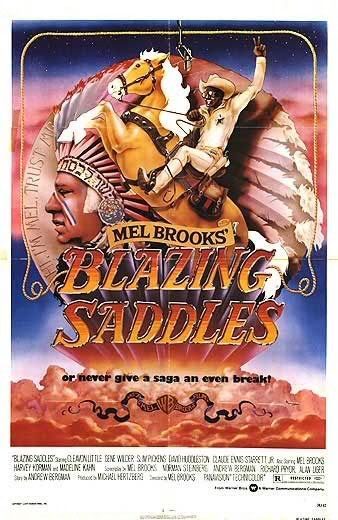
 A funny thing occurred to me while watching Mel Brooks' 1974 acknowledged comedy classic Blazing Saddles, right around the scene where Sheriff Bart (Cleavon Little), still trying to find his way around the town of Rock Ridge, attempts to greet an elderly woman in town. (Her response: "piss off, n***er") At some point, it'll strike you that all of Brooks' films - whether good, bad or somewhere in the middle - contain the same brand of effected, almost forced, humor.
In Young Frankenstein, it might be Igor's command to Frankenstein to (quite literally) "walk this way." In Robin Hood: Men in Tights, just pick a joke: whether Ahchoo's hip-hop sequence or Maid Marian's Everlast chastity belt. Hell, he even makes reference to Blazing Saddles at one point! Brooks uses these sorts of routines so much that they ultimately belittle his comedic gravitas.
But what we realize with Brooks is that, with all of his jokes being made in a similar manner, it's really not the humor by which his films must be judged; it's the individual storylines and, more importantly, how successfully he weaves the humor into them.
And by that notion, Blazing Saddles really isn't a great film. Sure, you'll get your chuckles; I certainly got mine. And, yes, its handling of racial prejudices so shortly after the civil rights movement is a great source of comedy, probably one of the reasons it's viewed as a classic.
When you look at it a bit closer, though, there's not much of a story. Rather, it's a series of smaller events that build upon eachother and ultimately lead to, well...nothing. The conclusion really doesn't follow the events of the rest of the movie. Its sheer randomness is akin to watching an episode of "Family Guy." Or the middle third of The Shining.
It starts with conniving Attorney General Hedley Lamarr (Harvey Korman) attempting to buy the town of Rock Ridge to destroy it and use the land for a railroad. The citizens, outraged, demand that their governor (Mel Brooks) send them a sheriff to maintain order and prevent their town's destruction. The sheriff is Bart (Cleavon Little), an African-American whom the 1874 Old West town predictably takes its time to warm up to. Hence, "piss off, n***er!"
The conflict is between Lamarr and Bart, and honestly can hardly be called a conflict at all. It's basically a series of cheap pranks, if you think about it: Lamarr tries to pull a fast one on Bart; Bart responds and turns the situation in his favor. Over, and over, and over.
Yes, you'll get your giggles, whether from Gene Wilder's "Waco Kid" (who "killed more men than Cecil B. DeMille!") or Madeline Kahn's Lili Von Shtüpp, a German chanteuse oddly reminiscent of Cloris Leachman's Frau Blücher. But the laughs never really amount to much because they're never quite given a solid context to fit into. As a result, the movie feels a bit stale before you've even reached the halfway point.
Don't get me wrong; I can see why Blazing Saddles is so well-loved. For its time, it's great; it has its place in history as a sort of building block toward the raunchy modern comedy of today. But in the end, it can't be judged as anything more than that.
2 stars out of 4
 Most people might debate over what exactly is the greatest aspect of a film like The Day the Earth Stood Still. It could be the solid acting performances of Patricia Neal and Michael Rennie. It could be the fear-inspiring qualities of the robot Gort. Or it could be the collective sentiments that the movie evoked upon its initial release to the world, which was at the time mired in Cold War angst and xenophobia.
But no, the greatest trait of this cinematic gem is the fact that it is as utterly mesmerizing a film in 2008 as it was 57 years ago, in 1951. Sure, its context may have changed but its overall campaign for peace and understanding resonates as loud as ever. It's a message the human race still has yet to learn, and one that hits even harder upon that realization.
We could all use the sort of rude awakening Klaatu (Rennie) and Gort (Lock Martin - truly more machine than man) bring to Earth. Imagine all of the electricity on the planet going out, for a half hour. It would be even more catastrophic in today's technology-driven world than it was then.
But at the same time, Rennie brings an odd sort of comforting presence to Klaatu. He's an alien bringing a warning of destruction to the planet, yet he makes you feel so at ease through it all. He takes young Bobby Benson (Billy Gray) sightseeing throughout DC and solves seemingly unsolvable equations for the eccentric Professor Barnhardt (Sam Jaffe), and is equally convincing in each facet of his Earth persona, Mr. Carpenter.
What's more, his performance brings out the best in his co-stars, making them more believable and, thus, the film more likable. All things considered, Patricia Neal on her own is rather uninspiring as Helen Benson, but she has a certain chemistry with Rennie that allows you to overlook it all.
Given the upcoming remake, it might be easy to overlook the artistic side of things. How can a film from the 50s possibly compete with 21st-century blockbuster? In much the same way that the 1933 version of King Kong trumps Peter Jackson's recent remake: the effects are there to augment the film, not to drive it. By not assaulting our senses with cheese, director Robert Wise lets us truly appreciate his special effects for the time period from whence they came - whether the spaceship travelling to Earth or Gort's creepy eye-beams that melt anything he chooses.
I could go on, but I'd likely be here for weeks listing all of the positives. Put simply, The Day the Earth Stood Still is a sci-fi classic and an indisputably great piece of filmmaking - as relevant today as it was half a century ago. But don't take my word for it. Rent this, and let the movie do the talking...
4 stars out of 4
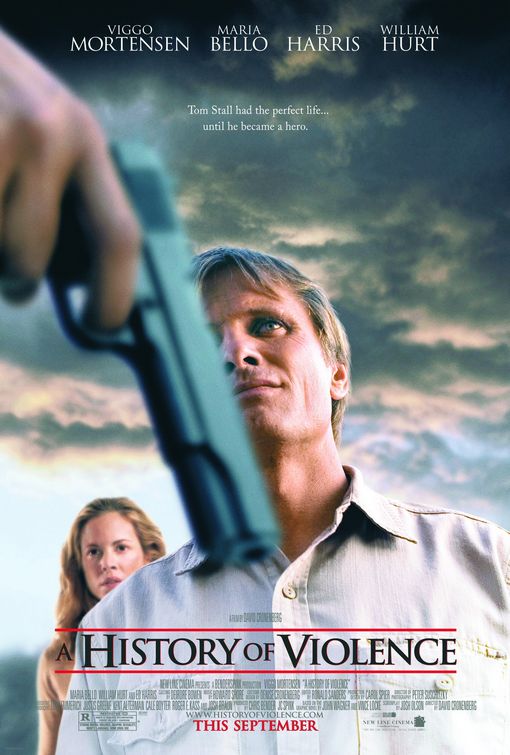
 Split-personality characters rarely come as mysterious as Viggo Mortensen's in A History of Violence.
On one side, he's Tom Stall - married with two kids, the mild-mannered owner of a diner in small-town Indiana. People in his town know him because, well, everyone knows everyone. Until, that is, he kills a couple of criminals one night in his diner in self-defense. Then people know him for being a hero.
And it's then that his other side comes out. The news of his actions travels fast, and before long, Tom's being stalked by a creepy mobster from Philadelphia (Ed Harris) who believes him to be one of his crew and, in fact, called Joey Cusack. Another mobster. A violent one. A killer.
It's a credit to director David Cronenberg that A History of Violence doesn't reveal anything too soon. But unfortunately what ends up being the film's biggest downfall is that there are some things it doesn't reveal at all. So in the end, the Cronenberg-Viggo pairing IS, once again, a success. Just not as big as the duo's next excursion, Eastern Promises.
However, the movie's good enough for the most part to keep us interested in spite of these shortcomings. In addition to the mystery behind Stall/Cusask (which one is he?), the movie's true gusto as a thriller comes from the manner in which Tom's conflict comes to affect his family. We're left not just worrying for his safety and outcome, but for theirs as well. We see it strike his wife, Edie (Maria Bello), whose paranoia turns to fear and again into anger over her husband's predicament. But it comes through strongest in his son, Jack (Ashton Holmes), who transforms from a mild-mannered high school loser to a vicious fighter as the movie progresses.
Unfortunately, the plot holes prove too many to overcome, particularly toward the end of things. There are also some miscasting issues, namely Bello - who should really just retire from cinema altogether. But if Bello's performance is of her typical, unsympathetic self, then there is another miscasting in A History of Violence that is truly deplorable - William Hurt as another Philly mobster, unconvincing and overhammed, apparently, enough to receive an Academy Award nod.
All in all, not bad. Cronenberg and Co. have whipped up a crafty, satisfying thriller that should wind up entertaining all. But if we consider his pairings with Mortensen as we would a sex life (not entirely inappropriate, considering their next film), A History of Violence is kind of like that all-important "first time" - something to talk about, something to remember, but ultimately not as good as what's to come.
3 stars out of 4
 On September 11, 1971 - an interesting date, if you think about it - London experienced one of the single biggest robberies in its history. It saw nearly £3 million in cash and goods stolen from a Lloyds Bank branch at the corner of Baker Street and Marlyebone Road in a heist that (appropriately) became known as the Baker Street robbery. Of the thieves or the aftermath little of substance is known, but the two have become widely speculated urban legends ever since.
Which brings us to 2008, and the Hollywood retelling of these events, The Bank Job. The producers took full advantage of the fact that so little is known about the robbery, turning the movie essentially into a 1970s British version of Ocean's Eleven. But instead of being overwhelmed by celebrity (ultimately the downfall of the Ocean's franchise), we end up being enthralled by what's important - the story and its presentation on screen.
Jason Statham shines as head robber Terry Leather in a rare role that doesn't waste his charisma. For every decent film Statham makes, he usually follows up with two or three abysmal ones. (So following The Bank Job...well, let's worry about that when it happens...) Here, he excels as the leader of the group, exuding a certain air of confidence even in the most precarious of situation. It's his handling of things above all that keeps our eyes glued to the screen.
It's hard to tell where reality stops and imagination begins in The Bank Job, but here's the general idea of things: an old fling of Leather's named Martine (Saffron Burrows) presents him the opportunity for the robbery. Terry's had his share of mischief, but this job represents a chance for he and his friends to take the next step and make out big. They take it.
But, as has become incredibly predictable in these sort of films, the crew gets more than they bargained for. Tension from all directions mounts, from the love triangle of Terry, Martine and Terry's wife Wendy (Keeley Hawes) to the continuing struggle against aptly named political activist Michael X (Peter de Jersey). Add in police corruption and a veteran London porn king, and you get a movie whose plot you can never really figure out until the end. Not a bad quality to have in a movie, though, is it?
The biggest success of the film is the crew, with each character as endearing and believable as the next. The lone exception is Burrows, whose importance to the film is undermined by a dry, unsympathetic performance. But then, she's not really part of the team anyway. Oops, did I just give something away?
Oh well, it's a minor detail in a movie with thousands. For all it's Hollywood-ing, The Bank Job is as good a heist movie as there's been in at least 20 years, if not ever. So kick back, grab your popcorn, and get ready to be entertained.
3 stars out of 4
 Captivating, heart-wrenching stories aren't often found among video gamers, and even less so in documentaries about video gamers. But apparently Seth Gordon missed that memo. In his documentary The King of Kong: A Fistful of Quarters, he pulls one off - presenting the saga of one Steve Wiebe and Billy Mitchell.
Mitchell's the old master, holding high-score records in five classic arcade games and even gracing his own trading card. (You think I'm joking, but watch the movie; by the end, such a statement doesn't seem remotely far-fetched.) For years, his score of 874,300 points in Donkey Kong was a world record.
Until, that is, Wiebe came along, submitting a videotaped score of more than one million points to video game records keeper Twin Galaxies. But because of the many rules and technicalities in competitive gaming, his score is scrutinized and eventually dismissed altogether. Determined to prove his legitimacy, Wiebe crosses the country to popular east-coast arcades to establish himself.
What follows is an escalation of Mitchell and Wiebe's competition into what video game referee Walter Day calls "one of the great rivalries of all time." (You really can't make this stuff up.)
There's Mitchell - the New York Yankees of the two - and his ascent from teenage gaming prodigy to one of the world's most popular gamers. He's one of those perpetually lucky people who seems to win at everything, from gaming to the running of the popular Rickey's World Famous Restaurant chain. Then there's Wiebe, who's more like the Red Sox were for all those years before breaking their "curse." A middle school science teacher, Wiebe's life is chock full of ups and downs (mostly downs, from his high school baseball career being cut short to his firing from Boeing).
But we also see Gordon pull off a rare trick. He gives us something that transcends being a mere "documentary" and merits judgement as a true "movie." The film runs the emotional gamut, giving us comedy with heartbreak and happiness alongside anger. In short, it informs us, but it also entertains us in a way that eludes far too many modern movies - by completely enveloping its viewers.
We see Wiebe emerge as the dominant persona, and watch our emotional highs and lows mirror his own. As he sheds a tear over the unfortunate ending of his quest, we nearly do the same. We also see Mitchell become less and less likable as the story unfolds, at first inspiring feelings of uneasiness which gradually progresses into anger and resentment.
Launch into arguments about what this movie's appeal says about our society if you wish. I did. But then, allow yourself to sit down and watch it with an open mind. With any luck, by the time the credits roll, it will have opened your eyes as well.
3 stars out of 4
Contrary to what some of you may believe, I did, in fact, survive my fall semester at SU and am now bored out of my effing mind less than 12 hours into my break. Consequently, Ahh, Cinema...will hereby be re-enacted for the duration of my winter break, to keep me sane and my writing sharp. Look for my first review in almost four months a bit later tonight.
Cheers,
-Dan
 When people mention that Tropic Thunder is a satire of all things Hollywood - overzealous actors, greedy and disconnected executives and the perversion of the creative process - you might not initially realize how far they've taken it. The movie is a commentary on the familiar faces in the industry - the moguls and the mega-stars, but it is also one of its fans, its critics, its techniques, its very MO.
Take, for example, the opening of the movie. Before we see even a frame of the movie-within-a-movie, we're treated to an attack on the commercialism of Tinseltown, through fake ads (a sports drink called "Booty Sweat," and its accompanying "Bust-A-Nut" bar) and, eventually, movie trailers. There's the sixth installment of action star Tugg Speedman's (Ben Stiller) "Scorcher" franchise, followed only by Jeff Portnoy (Jack Black) doing his best Eddie Murphy imitation in "The Fatties: Fart Two." And to close it out, we get the art house drama "Satan's Alley," a kind of medieval Brokeback-esque romance between two monks (Tobey Maguire, and Robert Downey Jr.'s on-screen ego, Kirk Lazarus).
Stiller, who directed and co-wrote with Justin Theroux and Etan Cohen, is no stranger to comedy. His parents - Jerry Stiller and Anne Meara - made up one of the enduring comedy duos of the 1960's, so it's basically in his blood. His last venture into directing was 2001's Zoolander - a wildly hilarious satire of the vanity and ignorance of the modeling industry. Yet deservedly or not, most people would probably point to Stiller's comedically-flawed characters as the apex of his talent.
And we see a little bit of all of them here in his newest role, action star Tugg Speedman. Speedman's a Stallone type hero, who, in dealing with his decreasing relevance in Hollywood, sort of reminds us of Stiller's past lovable loser roles in Meet the Parents or There's Something About Mary. But as he leads the team of actor-soldiers on the set of the war flick, there are flashes of his gung-ho, strictly business types, as in Dodgeball's White Goodman.
But after a failed attempt at serious drama playing a mentally retarded farmhand named Simple Jack, his next role is very much a make-or-break performance for Speedman. So for this adaptation of a Vietnam vet's memoir, he teams up with the comedian Portnoy and the award-winner Lazarus, who's had his skin darkened so as to play the platoon's African-American Sgt. Osiris. (Before anyone says anything, it's not a knock on African-Americans; it's a knock on the actors who think their talent and range are limitless.) Hot new rapper Alpa Chino (say it out loud) and relative newcomer Kevin Sandusky (Or is it Kyle? They never seem to know) round out the troop. And almost before anything happens, there's already trouble.
Struggling with a rookie director (Steve Coogan) and numerous financial catastrophes in the shooting, the film is finds itself a month behind schedule only five days in, and the studio executives (Bill Hader and a surprisingly funny Tom Cruise) aren't happy. And the stars couldn't appear to care less; they're too preoccupied with the setup of their on-location TiVo systems or the occasional call from an agent (the scene-stealing Matthew McConaughey).
So the Vietnam vet (Nick Nolte, looking not entirely unlike his recent mugshot) proposes that the filming be moved deep into the jungle and shot guerrilla-style, and it's here that Tropic Thunder takes on a new direction. It's not as much a movie about the making of a war-movie anymore; once they're thrust into the wild, attacked and captured by drug lords, you know it's become strictly a war-movie on its own. The trouble is that now we're dealing with two brands of humor that don't exactly level up with each other.
On one side, there's the occasional dip back into Hollywood-land and all its side-splitting hysteria, as the studios react to their stars' abductions. This is the kind of humor you wish the entire flick was made of, as executives mistake ransom phone-calls for agency negotiations and big-headed stars utter lines like "I don't read the script; the script reads me."
But unfortunately, this is often buried beneath a feeble attempt at action-comedy. Here, they'll try just about anything to make us laugh - from stereotype jokes (a "you people" interaction, along with a hilarious new entry to the moviegoer's vocabulary - "full retard") to obscenity-laced rants in drug deprivation. Sometimes they work, but more often than not (excuse the pun), they misfire - meriting little more than forced giggles that pale in comparison to the earlier belly laughs.
And it's this unevenness that ultimately drags a promising movie down. As the film comes from its brief moments of brilliance to be dominated by the stupider bits, we find ourselves too often on the fringe - unsure of whether we really like the movie or not. Mere instinct suggests that it might someday be a grower, but for now, it's just OK. War is hell, indeed.
2 stars out of 4
 A man awakens from an immeasurable sleep to find himself in a hospital room. His blurry vision slowly outlines two figures, which become a throng of people surrounding him and trying to communicate. He feels normal, if not slightly incapacitated from his slumber. But as he tries and fails to communicate with those around him and his medical state slowly becomes apparent, we discover he's anything but. "Normal," has become a thing of the past; this man's life will never be the same.
Such was the case for French journalist Jean-Dominique Bauby. Following a massive stroke in December 1995, the former Elle magazine editor awoke to discover he'd developed "Locked-In" syndrome, leaving him awake and entirely aware of his surroundings but deprived of motion or speech due to near complete paralysis. The only part of his body left mobile was his left eyelid. Slightly incapacitated, indeed.
But with that eyelid, Bauby devised a system of communication that allowed him to write his memoir, The Diving Bell and the Butterfly. As a transcriber read off a list of letters, Bauby would blink his eye to choose the right ones, forming words and eventually a chronicle of his life following the stroke. He wove together details of his post-stroke life, from interactions with visitors to simple procedures like bathing, with descriptions of his life before the condition, garnering critical acclaim and numerous best seller honors across Europe.
Ten years after its publication and Bauby's subsequent untimely death, director Julian Schnabel gives us a movie adaptation as beautiful and inspiring as the story and work from which it's adapted. Shot fittingly from a first-person camera perspective, the film attempts quite literally to take us inside Bauby's head following the discovery of his condition. It's a technique that makes us rethink traditional cinema, and it allows us to not merely watch the story unfold, but to live it.
It also, unfortunately, undermines an admirable performance from Frenchman Mathieu Amalric. Though his face-time may be lacking, Amalric shines as a personification of Bauby's remaining active, living qualities. Only Bauby truly knew what was going on inside his head, but thanks to Amalric's performance and a stunning script from Ronald Harwood, the movie delivers the best of both worlds. The audience gets a respectable interpretation of his life on this side of the condition, and Bauby, most importantly, gets a voice.
The voice may just be the most important part of the film, elevating it from simply a great story to an experience we'll never forget. It would have been one thing to just show Bauby's experiences following the stroke. Surely, taking a bath or being sung to would have been entirely more laborious than before, but in all of these cases, Bauby had help. Lacking most functions, he had to share these tasks with his attendants. So as important as they are to the telling of the story, the realization that they've all been lived before by people other than Bauby takes away a bit of the shine.
But nobody's ever seen inside Bauby's head before, which renders the glances inside that much more intriguing. If that renders Schnabel's efforts as quasi-novelties, so be it. Novelties they may be, but they make the film a far more emotionally-rewarding experience. It would have been hard to duplicate the anguish in the interactions between Bauby and his wife (Emmanuelle Seigner) or his father (Max von Sydow, in a touching cameo) without it. Because we know there's someone inside trying but incapable of responding to their desperate pleas, it makes the content nearly as taxing for the audience as for those involved.
Take, for example, an early interaction between Bauby and his aide, Claude (Anne Consigny). Having just devised the basis for their communication system, Bauby strings together a series of letters telling Claude "je veux mourir" - "I want to die." With us essentially inside Bauby's head, the feelings and the message start to feel like they're sprouting from our own, which ultimately lend a new appreciation of the lives and capabilities we all have.
His journey from this moment at rock-bottom to having completed his memoir becomes one from which we cannot look away. While it is a bit difficult to relate to Bauby in his "Locked-In" state, the frequent trips back to his normal past life tie our insides in knots. They remind us that such ailments can happen to anyone, encouraging us on a deeper level to live our lives to the fullest. Bauby may not have before his stroke, but this documentation of his perseverances after show us that he certainly did in later life.
4 stars out of 4
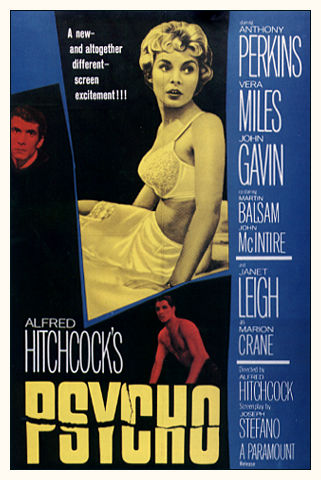
 Horror films have a way of working themselves into their audiences' moviegoing lives. And despite the current laughable state of the genre, at some point in our lives, we've all shuddered during moments of terror, let out screams as a killer plots his next move against unsuspecting victims. And then there's the calling card of horror - the slasher sequence. Who among us can claim never to have hidden their eyes during such a scene? And as people who've experienced these noted side effects of the genre, we owe a debt to Alfred Hitchcock's 1960 genre-definer, Psycho.
In discussing such a film, the temptation strikes to give you its resume - the numerous accolades it's received over the years. Take a quick look at the IMDb or the American Film Institute website, and you'll find all you need - everything from its elevated ranking among the greatest films of all time to deserved recognition for Bernard Herrmann's chilling soundtrack, as much a factor to the film's invocation of fear as the fates of its characters.
Indeed, it is hard to dispute Psycho's sterling reputation in film history, especially within its genre. Admirably filmed so as not to appear dated nearly 50 years later, its depictions of sexuality and violence were nothing short of revolutionary, blurring the lines between "acceptable" and "taboo" in cinema. And then there's its villain, murderous psychopath Norman Bates (Anthony Perkins) - among the most haunting characters in history. But a perfect movie? Not quite. Sorry, but this one isn't even Hitchcock's best.
Janet Leigh's performance as Marion Crane tends to get top billing in this movie, especially after her infamous shower sequence, but this is really an unfair presentation. Indeed, Crane kick-starts the story by stealing $40,000 from an employer, ultimately leading her to the ominous Bates mansion and accompanying motel. It is a testament to Hitchcock's skills as a director that the film is as thrilling as it is even before she meets its namesake. Her adventures are such that stumbling upon the empty, darkened motel comes as a great relief, to both character and audience alike.
But beyond this, and her final piercing scream, her role is non-existent. The true terror of the movie comes as we get to know Bates, which only happens once Crane's sister Lila (Vera Miles) and lover, Sam (John Gavin) become involved after her disappearance.
The further they dig, the creepier Bates becomes - his mysterious mother and bizarre responses to simple interaction with other people rendering an earlier development, his unorthodox hobby of taxidermy, seem almost normal. And through it all, Perkins handles the role with an effortless grace that makes it that much more believable and thus that much scarier.
We grow to realize that Bates is truly mentally ill, that he really is a psychopath. This makes sense; the film's title is, after all, "Psycho," not merely "Killer." In theory, such a designation could only enhance the story. The criminal's true motives can no longer be clearly identified; we now have to deal with the origins of his condition, his awareness of the crimes he's committing, and countless other factors.
And for as important a development as this is, it's a bit disappointing to see Hitchcock and Co. handle its realization on film so poorly. We get the explanation all at once, placed in such a spot of the movie so as to completely kill any momentum it'd built up throughout. As a result, we're left with a poor aftertaste in our mouth, one that returns an otherwise classic to the realms of mere mortals.
3 stars out of 4
 Let's get one thing straight right off the bat: Trailer Park Boys: The Movie is stupid. Undeniably so - one of the stupidest movies you'll ever see. It suffers from haphazard, mockumentary-style filmmaking (as per the hit Canadian TV show from which it was adapted), poor storytelling (and, let's face it, a poor story to tell) and above all, a cast of petty criminals and druggies who are often too bizarre to be taken seriously. It's not quite the level of artistry you'd expect from a high-schooler, but it's not too far off, either.
But with that stupidity, series creator/director Mike Clattenberg may just be onto something. The movie may have all of these negative qualities going for it, but it also has a true positive in its originality. You don't get that seeing the same old Will Ferrell/John C. Reilly shtick rehashed for the umpteenth time. Indeed, there's a certain quirkiness to these Trailer Park Boys, one of whom lives out of his car and another in a garden shed. And it strikes you in such a way that, by the end of the movie, you kind of start to like them.
That would appear to be the case, anyway. The TV program recently wrapped up the seventh season of adventures for Ricky (Robb Wells), Julian (John Paul Tremblay) and Bubbles (Mike Smith, doing his best impersonation of the legendary "Milton," from Office Space). Their "universe" - a Nova Scotia trailer park called Sunnyvale - is an odd one, but its inhabitants and the situations they find themselves in truly make one appreciate what we have in the real world. Which, for a movie of this sort, is certainly an achievement.
Early on in the film, Ricky and Julian are sent to prison for 18 months for robbing a gas station. Once they're released, though, they find some major changes underway in Sunnyvale. Ricky returns home to find the stability of his family life falling apart. His girlfriend, Lucy, has taken up stripping at a local gentleman's club, and may or may not have become a lesbian, and their cigarette-smoking daughter (all of about 9 years old, mind) has started stealing barbecue grills and selling them at flea markets. I could go on, but why ruin all the surprises?
Their time in prison has left the boys with a newfound desire for pulling off "The Big Dirty," a dimwitted new scheme that involves stealing large amounts of change. If there's any shock to the revelation that this plan trumps all their earlier crimes, it will be nullified once you meet their crew - including a pair of inept stoners who ride around on a snowmobile and Ricky's father, who pretends to be handicapped so as to claim disability checks from the government.
Throughout their quest, a multitude of things go wrong. And as each new bump in the road is reached, it's a testament to the stupidity of the movie that everything ultimately gets resolved. Sometimes, it's almost an insult to our collective intelligence as an audience the way they try and pass things off. A courtroom sequence that will decide the boys' fates sees their charges dropped almost at the snap of a finger for reasons that should, effectively, have prevented the case from even going to trial.
But at the same time, the boys set their stupidity in such a context so as to make it kind of enjoyable. Their brand of humor is not easily identified, initially. In fact, most of the time, it requires a good minute or two of thought to decipher. But that extra thought process reveals a new brand of hilarity, making the laughs deeper and more rewarding. I'd hesitate to encourage you to check it out, but if you go in expecting, you might just leave with a smile on your face.
1.5 stars out of 4

A movie's success is often measured by its degree of originality. Certainly, being well made and/or thought provoking can't hurt its chances, but ultimately, the reason to see a movie is for that little something new. What have they done differently? What haven't we seen before? This is especially true in the teen comedy genre - one formulaic and meandering almost by nature.
It seems director Jon Poll missed that memo before filming Charlie Bartlett. The film isn't entirely unlikable, but it sure does its best to seem that way. By offering up stale, second-rate versions of situations we've already encountered in similar movies, Poll and writer Gustin Nash turn what could have been promising into a disappointingly average flick.
We all know kids like Charlie Bartlett. He's that kid in high school who just wants to be popular, but who wants it so badly that his goal gets out of hand. Whether through our own personal experiences or through the countless teen comedies featuring similar protagonists, we've gotten to know people like him. There's also the misunderstood tough guy who turns to bullying for a fleeting sense of self-security. Oh, and the creepy, anonymous and possibly suicidal nerd and, of course, the sweet young girl who struggles with a parent on the school faculty. Been there, seen that.
That's the trouble with Charlie Bartlett - its characters and their conflicts are all so familiar to us going in that they come off even more mundanely than the first hundred times we saw them . The film wants to triumphantly win us over - the way Charlie (Anton Yelchin) wins over the world in his dream sequences. But instead we're left struggling to combat boredom as we would in an overly-long history class.
Which is not to say the movie's a total loss. If it can't uplift us through the emotional victories of its protagonist, we at least get the occasional chuckle from its fish-out-of-water satire as wealthy Charlie and his mother (Hope Davis) simultaneously adjust to his life as a public school student. Mischief and poor judgment have led to Charlie's expulsion from boarding school, and the obliviousness with which the Bartletts attempt to tackle their new arrangements is not only hilarious, but surprisingly accurate.
It seems that Poll thought this slightly redeeming quality, along with Yelchin's charisma and the mere presence of Robert Downey Jr. as school principal Nathan Gardner, would be enough to carry the movie to success. Those two work well enough together to carry Charlie Bartlett on their backs for a while, as Gardner contends with Charlie's mischief throughout the movie. Unfortunately, their luck runs out, and this overly-recycled take on the high-school comedy genre simply doesn't work out the way you'd hope.
1.5 stars out of 4
Apologies for the absurd delay in posting. It won't happen again, at least not until I get back to school.
I've been thinking of trying a new rating system. The "out-of-10" rating is gone, and I'll rely strictly on stars. The reason? Numbers, I've grown to realize, only make things more difficult. They invoke comparisons between movies that have no connection whatsoever to each other, and really just make things more difficult. A star system gives a broader scope of evaluating a movie's success, allowing one to express like or dislike for a movie without unnecessarily viewing it in terms of another movie's rating.
Just giving it a shot. Hope it works. And now...

"He who prides himself upon wealth and honor hastens his own downfall" -Lao Tzu
Few film protagonists embody the lesson of this proverb more than Charles Foster Kane. Throughout Citizen Kane, his rise to improbable glory is rivaled in significance only by the bitter end he meets. Despite the illusion of "having it all," Kane is a character who starts and ends his life in the same manner - with nothing. The slow degradation of his reason and relevance throughout the film, coupled with the alienation of those around him, render his wealth and power a moot point.
Take, for example, the crown jewel of his fortune - the palace of Xanadu. Designed (but never finished) for his second wife, Xanadu casts a pall over the film right from the start. The gloomy opening shots of an empty fortress silhouetted on the smoky island background set the tone throughout the film.
Kane dies shortly thereafter, but it's not until the rest of the film unfolds that the circumstances of his life become apparent. It's essentially a series of extended flashbacks, as those formerly close to him tell their accounts of how a man on top of the world lived his life so as to leave this world unstable and alone.
The small boy who became heir to a silver-mining fortune transforms into a man (Orson Welles) unsure of a direction in which to channel it. Immediately, hints of an uncertain future present themselves. He drops into and out of several prestigious colleges, before finding the mysterious wisdom to invest in a small New York paper, the Inquirer. For the first several years, they lose $1 million a year, yet Kane could not appear to care less. You don't exactly know what's coming, but little clues like these suggest a bitter ending for the sleazy, yet somehow likable millionaire.
As he builds his empire, Kane's years on top are spent erratically. He woos the top editors from a rival paper into defection, only to travel to Europe and spend lavishly on vintage pieces of sculpture and other artwork. He marries a wealthy young woman, only to jeopardize the stability of their relationship through an ill-advised campaign for political office. And as everything unfolds, the audience is left uncertain how to react. Welles' charisma begs us to feel sorry for him in the wake of each new catastrophe, but the habitual deference to his own massive ego and its poor decisions makes us realize he has it coming every time.
It eventually all comes full-circle in Xanadu, in a scene that is simultaneously the film's most wrenching and its most memorable. Scene after scene of noticeable decay in Kane's relationship with his second wife, Susan (Dorothy Comingore), result to his eventual discovery of her plans to leave. "You mustn't go," he begs her. "You can't do this to me." And like Susan, we see right through him as he reaches the point of no return.
"You don't love anybody," she retorts. "You want to be loved! That's all you want!"Everything - his fame, his relationship - is about Kane. Things meant to be mutual become singular; life's supporting cast is mere afterthought. There are hints at this as the distances between Kane and those close to him widen throughout the film, but it's not until this scene that we're really hit and left pondering the natures of wealth and power, and how they influence those upon which they're bestowed.
The film's contributions to and influences on modern cinema are too many to count: innovative camera angles, use of miniatures...the list goes on. But what everyone will remember is the establishment of a Hollywood renaissance man in Welles. As a director, producer and co-writer, he worked to create a truly remarkable film that would acknowledge the past as well as shape the future. But as an actor, he did one better - creating a character who we both envy and pity, whose fate will haunt us forever. Simply unforgettable.
4 stars out of 4
9/10
 It is one thing for a movie to document change in its protagonist, and not a very rare thing at that. We've seen it hundreds of times, from Schindler's List to Into The Wild and even as recently as There Will Be Blood. Such transitions are usually where films get their gusto, as they result, perhaps, in a loss of the character's normalcy, but ultimately make the characters deeper and more compelling.
However, it is another, much rarer thing entirely for a film's protagonist to change and then effect the same change in others. It's more powerful, more satisfying; whatever the character's motivation for change was, it's powerful enough to spread contagiously. It's this sort of change that director Tony Kaye evoked in American History X, the story of a Neo-Nazi and white supremacist in modern day Venice Beach, California. It's a gripping, powerful story, one equally as likely to uplift you as to break your heart.
Edward Norton gives a stunning performance as Derek Vinyard, the young man initially smothered by his prejudices after the murder of his father, a firefighter, in south central Los Angeles. His actions and appearance (shaved head, numerous tattoos advocating the Nazi Party and "white power" slogans), make him our main point of focus (or is it engrossment?) as the movie unfolds. And given his performance, this may not seem like a bad thing, but in reality the movie's as much about his younger brother, Danny (Edward Furlong), who seems poised to follow the same path. The two characters are equally vital to the film, thanks to writer David McKenna's flashback-oriented system of storytelling.
Through an early meeting with Danny and his high school's black principal, Dr. Sweeney (Avery Brooks), we learn of Derek's imprisonment for the murder of two black gang members, and of how closely Danny appears to be following the same path. His paper on Hitler's "Mein Kampf," forces Sweeney to establish a daily one-on-one class for Danny, called American History X - more an attempt at reform than a history lesson.
As his brother's release nears, Danny's similarities become striking. He hangs out with the same racist kids, decorates his room with the same Nazi propaganda. His head is shaved, and he's even gotten his first racially-tinged tattoo. But when Derek arrives back home, he's not impressed. Something about his character is different - his motivation for life seems to be coming from a different place. But it's not until he breaks up a party of white supremacists to save his brother that any of this is confirmed. His days of racism and bigotry are over.
What follows, as a frustrated Danny demands an explanation, is an emotional, multi-leveled flashback. It brings into light the things we'd wondered about throughout the film: how bad things had gotten in the Vinyard house, the exact details of Derek's crime. The most important piece of the puzzle is Derek's enlightening experience in prison, told unabridged as he attempts to convince Danny not to follow the same path.
The ending unfolds a bit abruptly, but it's one of the more hard-hitting conclusions in recent memory. The film is not only deeply saddening, but also thought-provoking. It makes you really ponder the sources of such unhinged, uncontrolled anger as we see portrayed on screen. And, as you'll see, the reality of it might come as a surprise.
3 stars out of 4
7.5/10