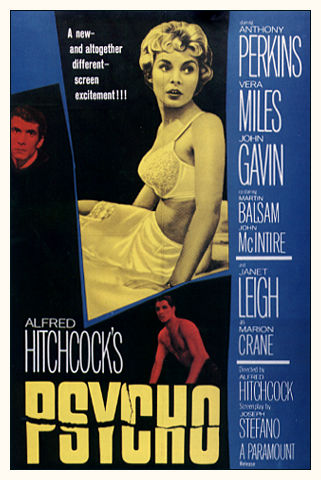
 Horror films have a way of working themselves into their audiences' moviegoing lives. And despite the current laughable state of the genre, at some point in our lives, we've all shuddered during moments of terror, let out screams as a killer plots his next move against unsuspecting victims. And then there's the calling card of horror - the slasher sequence. Who among us can claim never to have hidden their eyes during such a scene? And as people who've experienced these noted side effects of the genre, we owe a debt to Alfred Hitchcock's 1960 genre-definer, Psycho.
In discussing such a film, the temptation strikes to give you its resume - the numerous accolades it's received over the years. Take a quick look at the IMDb or the American Film Institute website, and you'll find all you need - everything from its elevated ranking among the greatest films of all time to deserved recognition for Bernard Herrmann's chilling soundtrack, as much a factor to the film's invocation of fear as the fates of its characters.
Indeed, it is hard to dispute Psycho's sterling reputation in film history, especially within its genre. Admirably filmed so as not to appear dated nearly 50 years later, its depictions of sexuality and violence were nothing short of revolutionary, blurring the lines between "acceptable" and "taboo" in cinema. And then there's its villain, murderous psychopath Norman Bates (Anthony Perkins) - among the most haunting characters in history. But a perfect movie? Not quite. Sorry, but this one isn't even Hitchcock's best.
Janet Leigh's performance as Marion Crane tends to get top billing in this movie, especially after her infamous shower sequence, but this is really an unfair presentation. Indeed, Crane kick-starts the story by stealing $40,000 from an employer, ultimately leading her to the ominous Bates mansion and accompanying motel. It is a testament to Hitchcock's skills as a director that the film is as thrilling as it is even before she meets its namesake. Her adventures are such that stumbling upon the empty, darkened motel comes as a great relief, to both character and audience alike.
But beyond this, and her final piercing scream, her role is non-existent. The true terror of the movie comes as we get to know Bates, which only happens once Crane's sister Lila (Vera Miles) and lover, Sam (John Gavin) become involved after her disappearance.
The further they dig, the creepier Bates becomes - his mysterious mother and bizarre responses to simple interaction with other people rendering an earlier development, his unorthodox hobby of taxidermy, seem almost normal. And through it all, Perkins handles the role with an effortless grace that makes it that much more believable and thus that much scarier.
We grow to realize that Bates is truly mentally ill, that he really is a psychopath. This makes sense; the film's title is, after all, "Psycho," not merely "Killer." In theory, such a designation could only enhance the story. The criminal's true motives can no longer be clearly identified; we now have to deal with the origins of his condition, his awareness of the crimes he's committing, and countless other factors.
And for as important a development as this is, it's a bit disappointing to see Hitchcock and Co. handle its realization on film so poorly. We get the explanation all at once, placed in such a spot of the movie so as to completely kill any momentum it'd built up throughout. As a result, we're left with a poor aftertaste in our mouth, one that returns an otherwise classic to the realms of mere mortals.
3 stars out of 4


