skip to main |
skip to sidebar
 In the movie industry, true greatness is realized when a film transcends both time and genre. A great film is such without any qualifications necessary. And, nearly 30 years on, Ridley Scott's Alien continues to assert itself in greatness. It's science fiction without stumbling upon cheesiness; it's artistic without being pretentious. Most importantly, it's a movie so enthralling that its run time of two hours feels more like mere minutes passing by.
Scott would again delve into the sci-fi realm with 1982's Blade Runner, but not with the same level of success. The latter was just as futuristic and its conflict just as intriguing, but in spite of it all, it just felt like a bit much. An elevated degree of open-mindedness is required to get through that film, whereas in Alien, Scott somehow weaves everything together to make you feel at home right from the get go - even on a spaceship several hundred years into the future. It also helps having clear-cut heroes and villains; having an alien as an antagonist seems a better fit than a robot playing and looking the part of a human.
Some issues in presentation down the stretch, as well as some expendable roles (Harry Dean Stanton and Veronica Cartwright can hardly be blamed for their characters' shortcomings) ensure that the film is, in fact, human, and thus not perfect. But in spite of these issues, Alien still holds its own better than the majority of modern films - sci-fi or otherwise. How? It keeps us not just interested, but glued - all throughout. If that's not the mark of a great movie, what is?
4 stars out of 4
9/10
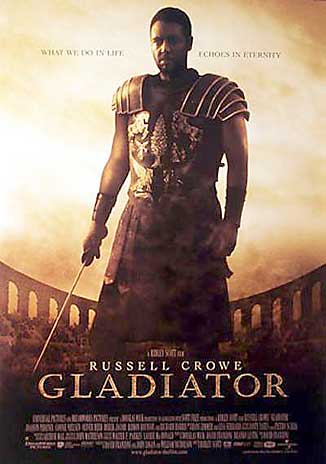
 Films must often be divided into two sub-categories. There are those that stand the test of time - not only enjoyable and praiseworthy upon first viewing, but many years ahead for and with future generations. Then there are the blockbusters, those movies made for summertime viewing - with action and mayhem often in the forefront and, in most cases, true quality on the backburner. With 2000's Gladiator, Ridley Scott gave us a gem that fit perfectly in the middle - all the roaring spectacle of a summer blockbuster in a film that could stand up and fight (no pun intended) among cinematic heavyweights of all generations.
The film occasionally gives us some effective emotional undertones throughout, but everyone knows the real reason to see Gladiator is its action sequences. Right from the get-go, we're thrust into battle as the Roman army, led by the general Maximus (Russell Crowe) under emperor Marcus Aurelius (the late, great Richard Harris) prepares to conquer the last resisting Germanic state to bring peace to the empire. While Crowe doesn't strike us as a natural hero, as both the scene and the film as a whole progress we discover that he's something far more valuable - an effective one. He has the gusto to slice and dice his way through the battles, while also maintaining dramatic sensibility in the calmer scenes.
His just and honorable conduct on and off the battlefield lead the dying Aurelius to bypass his own son, Commodus (Joaquin Pheonix) and declare Maximus the next ruler over Rome. This doesn't sit well with the power-hungry Commodus, and results in the son killing his father and forcing Maximus into exile.
What follows are two separate documents of rises to power. As Commodus tries various methods to divert the public eye from his shortcomings as a ruler, including re-introduction of gladiatorial games in Rome, Maximus works his way up as a slave and, eventually, a gladiator under his master Proximo (Oliver Reed). Through bonds formed with both his fellow slaves (Djimon Hounsou, Ralf Moeller) and his early match crowds, he's able to win over not just those around him, but us viewers as well - completely, in fact. "You have a great name," Hounsou's character Juba says at one point. "He must kill your name before he kills you."
The separation of the two primary characters works for a while, but is ultimately not as gratifying as their reunion. Maximus' reputation under the arena name "Spaniard" compels the emperor to demand a meeting with him. After this encounter, it's not just Commodus' villainous attempts to drag Maximus down (all handled rather admirably by Pheonix, if not a bit sissy-like at times) that keep our focus; the intertwining of their pasts and interactions between characters on both sides surpass that in both quantity and quality.
And as the movie's underwhelming last battle doesn't deliver, these such interactions end up saving the day, creating a fitting, emotionally grabbing ending. Actually, no. It's more than an ending; it's a conclusion, where an excellent film not only ends but caps off an epic journey, one that will undoubtedly be remembered among the greats in movies for years to come.
3.5 stars out of 4
8/10
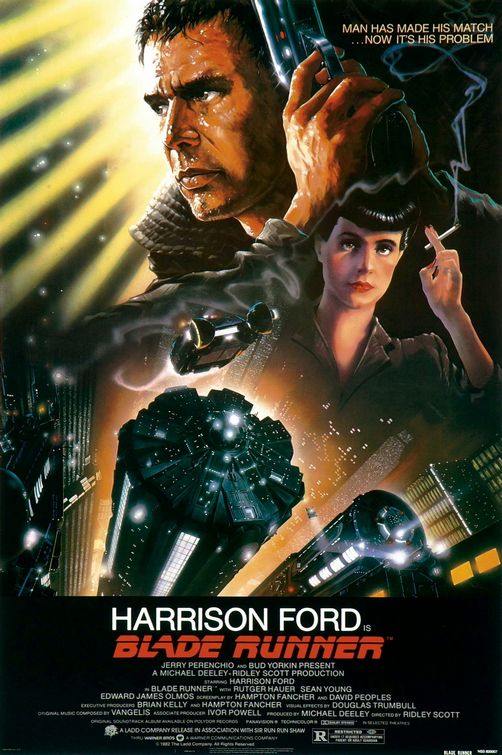
 If you can look past the über-cheesy production design of Blade Runner, you'll discover a film that transcends the typical dorkiness of science-fiction by establishing itself as a piece of art. Though Ridley Scott's futuristic vision doesn't quite matchup to that of his previous masterpiece, Alien, the rest of the movie is compelling enough to keep us interested, and then some. Though Harrison Ford received top billing as police specialist Rick Deckard, Rutger Hauer is the one to watch - truly a villain's villain as replicant Roy Batty. His performance here laid the groundwork for Nicholson's Joker and Hugo Weaving's Agent Smith, as well as countless other later villainous roles. The final battle between Roy and Deckard defines action cinema endings. It's what The Matrix wishes it could be - as reliant on action as on a hauntingly psychological dialogue between hero and villain. But then, Blade Runner is a film whose impact is not truly felt until the movie progresses - and once it hits, it hits hard.
3.5 stars out of 4
8/10