skip to main |
skip to sidebar
 Before we jump too far into Hancock, let's get one thing straight. Will Smith's latest action hero, the film's protagonist John Hancock, is (or is meant to be) a superhero. You know, those guys who fly around, fighting evil and ensuring that normalcy will prevail for everyone around them. They define what is "good" in the world, and try to spread that goodness through their feats. Or basically, they're, you know...super. I could, and will, go into a number of ways in which Hancock lets its audience down, but it is ultimately a lack of that last elementary quality that proves it a failure.
To its credit, at least there's something of a heroic journey in it. When we first meet Hancock, he's passed out drunk on a city bench while the police chase three hoodlums in an SUV down the highway. He gets into an argument with the young child who informs him of what's going on, eventually flying in and setting down the retreating vehicle and criminals snugly onto the communications tower of the Capitol Records building. With Hancock, heroics go hand in hand with unnecessary devastation and financial headaches, and he often engages (quite humorously, I'll admit) in post-feat arguments with the people he's saving. At any point during the first 25 minutes or so of the film, look up "asshole" in the dictionary, and you might just see his picture.
Yet it's not until he saves the life of PR man Ray Embrey (Jason Bateman) that any of this starts to matter to Hancock. After dropping Embrey off home, they conveniently happen upon a televised speech in which a city official publicly expresses anger towards and non-confidence in Hancock. With Embrey's insistence, Hancock decides to clean up his act and effectively begin his heroic journey. This, unfortunately, is neither as humorous nor as properly developed as it should be; with the crime rate in L.A. skyrocketing after his imprisonment, he's granted parole after less than two weeks.
But in spite of the rise in crime, there's never once a truly compelling antithesis for Hancock after his inner transformation. In his first bit of action after release, he saves a group of bank employees from a sadistic and, presumably, unimportant robber. This man is on-screen for all of five minutes, and Hancock disposes of him with relative ease. He's not someone you'd place in the same league as a Lex Luthor, a Magneto or a Joker. Right there, his story should be over. Kaput. Finished. And for a while you think it is. But from out of nowhere, he returns and tries to assert himself as a nemesis - failing quite miserably to do so.
We have to assume that the lack of a true villainous counterpart comes as a result of writers Vince Gilligan and Vincent Ngo channeling their energies improperly towards another plot element - an absolutely absurd twist involving Embrey's wife, Mary (Charlize Theron). Their move is unbelievable in the truest sense of the word, transcending mere ridiculousness by also managing to suck any and all life out of the movie with its dominant presence. It's something at which M. Night Shyamalan would wet himself laughing.
To go into a superhero flick expecting intelligent, thought-provoking writing on top of the layers of action sequences is a bit naïve. (Unless one Christopher Nolan is at the helm, but we've still got a week until his next move) To expect that from Hancock, which had been billed nearly as much as a comedy as a superhero movie, would have been just plain silly. But an audience can't be faulted for expecting competence, which is sorely missing in Hancock. That Gilligan and Ngo wrote this dud of a script is disheartening; that Peter Berg (or was it Michael Bay? I'm not entirely sure) tried to hide its shortcomings among bombastic action sequences and occasional laughs - without making any needed changes - is simply offensive.
Give credit to Smith, Bateman and Theron. They did what they could with such an abysmal piece of film-making. They work well as individuals and as an ensemble, and their chemistry here gives off a solid air of charisma - a lone shining star in a black hole of a film that really doesn't deserve them. It's sad to see their talents put to waste, and also a bit puzzling as to why they'd allow them to be, for there's nothing remotely super about Hancock. It's truly one of the worst superhero flicks in recent memory. Save your money and wait for The Dark Knight instead.
0.5 stars out of 4
2/10
 In 2006, Al Gore gave us his Inconvenient Truth - that the dangers of global warming were severe enough to ultimately wipe out the human race. And in spite of the generally warm reception it received, there were still doubters - both in the US and worldwide - still accusations of it being mere political propaganda. The next step, one that would convince people universally of the problem facing the world, needed to be taken. Two years later, in 2008, that step has been taken by an entirely unexpected pioneer - Disney/Pixar's newest film, Wall-E. And what a marvelous step it is.
Wall-E presents an even bleaker picture of the future than Truth. It's set 700 years in the future, as human beings have not only rendered Earth uninhabitable (through pollution and, presumably, climate change), but have also submitted completely to technology. The race now calls space home, and has become one of idle gluttony - dressed, fed, transported and entertained entirely by machines from the aptly-titled Buy 'N Large corporation, whose dominance would have made Carnegie and Rockefeller weep.
It's a profoundly disturbing prognosis. Were it not a Pixar flick, its dystopian forecast would likely drive children and parents alike away from the theater out of fear or denial. (Or both.) But under the command of director Andrew Stanton (Finding Nemo), Pixar has done it again - bridging the gap to create a film that is as successful a harrowing social commentary as it is a deeply entertaining family movie.
At the center of it all is Wall-E, a trash compacting robot (Waste Allocation Load Lifter - Earth-Class) who's the last of his kind left on Earth after a failed cleanup mission in the early 2100's. As the mission sent the human race into space, he's actually the last of any kind left on Earth. So the film begins accordingly with a half hour of, essentially, non-dialog that allows the charismatic robot ("voiced" by Star Wars' veteran sound engineer, Ben Burtt) to win us over. And as he does, we start to see a bit of ourselves in him. He takes care of a pet (a cricket), watches old movies on his iPod (oh, that product placement), collects crates of old toys and even struggles with the ladies.
The "lady" in his life is EVE (Extraterrestrial Vegetation Evaluator), a robot sent from the humans' current home, the spaceship Axiom, to investigate the sustainability of Earth. We've all experienced this kind of romance: EVE's sleek where Wall-E's a clunker, she's all business while he's just a curious goofball. And as he follows close behind trying to impress her, we start to realize that this is Pixar's most personal creation yet.
The pair ends up returning to the Axiom together, where the robots really run the show. It really makes you question your notions of life; as the obese humans live vicariously through their robotic hovering chairs, the robots are the only ones truly living - performing monotonous chores while also managing to squeeze in games of tennis. And as their time on the Axiom unfolds, the allusions to past science-fiction classics (Star Wars, 2001: A Space Odyssey...hell, even Alien star Sigourney Weaver voices the ship's computer) keep coming, giving us a healthy dose of nostalgia and further cementing the bond between the movie and the audience.
But what makes Wall-E unlike the other sci-fi movies it touches on is that it ultimately presents hope for humanity. What Stanton's saying is that even though the future looks grim, maybe - just maybe - there's a way around it all. It's that lesson that keeps Wall-E grounded, rather than becoming sci-fi overkill like the others. At this point, it would take a miracle to kick start a reverse to global warming. And Wall-E might just be that miracle.3.5 stars out of 48.5/10
 About two hours into Paul Thomas Anderson's Magnolia, his entire cast engages in a performance of singer/songwriter Aimee Mann's "Wise Up." As we jump from scene to scene and from character to character, the resounding repeated chorus of "It's not going to stop/'til you wise up" truly strikes a chord. Throughout the 188 minutes, its cast, divided into nine different storylines, has but one thing in common - complete and utter despair. Those with any sort of stability (either positive or negative) become conflicted and fragile, their shortcomings catching up with them and leading down a spiral into mental oblivion. Mann's right; it really doesn't stop.
Never has a film relied so heavily on the degradation of its personae, and never has one done so with such success. It's three hours of pure despondence, portrayed (quite disturbingly) through the situations of those involved along with the haunting presentation of Mann's soundtrack.
There's Quiz Kid Donnie Smith (William H. Macy), the famed veteran of a long running children's quiz show whose life has turned downhill since his appearance in the 1960's. He struggles to get by, working in an independent electronics store as he debates the merits of oral surgery in finding love. (Only P.T. could come up with something like that) His inner turmoil mirrors that of young Stanley Spector (Jeremy Blackman), a young child currently competing on the show under the constant pressure of his greedy father.
But the most compelling plight is that of the show's longtime producer, Earl Partridge (Jason Robards). Earl is terminally ill with cancer and lives under the constant care an unfaithful and manic depressive wife (Julianne Moore) and a hospice nurse (Philip Seymour Hoffman). His estranged son, Frank (Tom Cruise), practices a sort of chauvinist evangelism in selling his "Seduce and Destroy" lesson series, and wants nothing to do with his past - or his father. Each one involved in this saga is intriguing, but Cruise is a cut above the rest - his intensely emotional performance is nothing short of mesmerizing.
"The most useless thing in the world is that which is behind me," Frank says at one point, citing a lesson from his series. But his attempt to downplay his past through career ambition quickly unravels, as we learn the details and exactly why he has become estranged from Earl. Their reunion in the end is gripping, if not a bit too much to handle.
It's that sort of quality that ultimately drags the movie down in the end. Three hours is long for a film to begin with, but it's made much longer with such a constantly negative atmosphere. The negativity effectively becomes the prime focus of the picture, rather than the characters and their various storylines. At times, you sort of just wish Magnolia would end, so that their damages might be limited. When the end does come, it's a bit of an interesting sensation. As with any Anderson film, you get the undeniable feeling of having just witnessed a good movie, but unlike his other works - its excruciating nature eliminates any desire to watch it again.
3 stars out of 4
7 out of 10
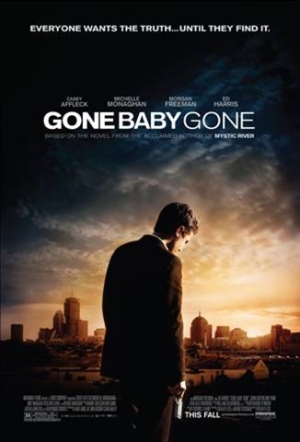
 It's one thing for a film to be entertain us, but it's another thing entirely to do so while making us really think. Ben Affleck's directorial debut, Gone Baby Gone, opts for the latter route, finding as much success as an intriguing crime thriller as it does as eye-opening lecture on morality.
Affleck adapted the film from a novel by Dennis Lehane (Mystic River), and cast his younger brother Casey in the lead of private investigator Patrick Kenzie. Early on, Kenzie and his investigating partner/lover Angie Gennaro (Michelle Monaghan) are hired to find a missing young child, also currently being pursued by the entire Boston police system. As their search goes on, we're treated to a variety of twists and turns in the plot and an even better variety of supporting characters, including Oscar nominee Amy Ryan as the girl's drug-addict mother and Ed Harris as the duo's Boston P.D. support. Even Morgan Freeman makes important use of his limited screen time.
It's a revelation for both Affleck brothers. Casey can finally emerge from his brother's shadow and assert himself as a serious and talented actor. After his performances here and in The Assassination of Jesse James by the Coward Robert Ford, expect more roles and acclaim to come his way. But it also makes a name for Ben as a director (his writing chops already made apparent by Good Will Hunting). If the guy never acted in another movie again and stuck with writing and directing, he might have a promising future in Hollywood. Only time will tell.
And just when you think the story's over and you have an angle on the movie, it starts up again, becoming deeper and more thought provoking than ever before. Comparisons will be drawn between this and The Departed, if for little more than the fact that they're both crime dramas set in Boston. But Scorsese's film, while intriguing, was purely for entertainment value, and Gone Baby Gone outdoes it in one key area - it makes us question our own previous notions of right and wrong. It does so without any shred of arrogance or pretense, seamlessly blending it all into the entertainment value.
All things considered, Gone Baby Gone is a rich, emotionally stimulating film - truly one of the best 2007 had to offer.
3.5 stars out of 4
8/10
 In the movie industry, true greatness is realized when a film transcends both time and genre. A great film is such without any qualifications necessary. And, nearly 30 years on, Ridley Scott's Alien continues to assert itself in greatness. It's science fiction without stumbling upon cheesiness; it's artistic without being pretentious. Most importantly, it's a movie so enthralling that its run time of two hours feels more like mere minutes passing by.
Scott would again delve into the sci-fi realm with 1982's Blade Runner, but not with the same level of success. The latter was just as futuristic and its conflict just as intriguing, but in spite of it all, it just felt like a bit much. An elevated degree of open-mindedness is required to get through that film, whereas in Alien, Scott somehow weaves everything together to make you feel at home right from the get go - even on a spaceship several hundred years into the future. It also helps having clear-cut heroes and villains; having an alien as an antagonist seems a better fit than a robot playing and looking the part of a human.
Some issues in presentation down the stretch, as well as some expendable roles (Harry Dean Stanton and Veronica Cartwright can hardly be blamed for their characters' shortcomings) ensure that the film is, in fact, human, and thus not perfect. But in spite of these issues, Alien still holds its own better than the majority of modern films - sci-fi or otherwise. How? It keeps us not just interested, but glued - all throughout. If that's not the mark of a great movie, what is?
4 stars out of 4
9/10

It seems somewhat ironic that a Biblical story meant to warn of the dangers of misguided ambition could lead to a film comprised of just that - misguided ambition. In the Bible, the Tower of Babel built to connect the human race to the heavens - not, in fact, to worship God. (This little snag led to God's separation of people and languages and, essentially, the world as we now know it.) It tells of the dangers of doing great things for the wrong reasons, which is interesting to consider in the face of Alejandro Gonzalez Inarritu's film, Babel. The movie focuses on a hit-or-miss (mostly miss) collection of characters whose actions all but eliminate any possible sympathy we'd have for them. It's essentially the polar opposite of the biblical tale; forget factoring motives into the equation of greatness - there's nothing great about them to speak of.
Babel gives us four different stories, each with characters from different dramatically flawed backgrounds. After the American couple (Brad Pitt, Cate Blanchett) - positively glamorous by comparison, we get more initially compelling personae like Chieko (Rinko Kikuchi), the Japanese deaf and mute girl who struggles for acceptance by those around her. It's all very emotional, and you'd almost be moved if part of the reason for her alienation weren't the fact that she's a complete pervert - sexually assaulting doctors and policemen one minute, only to make like Britney Spears and flash her...well, you know...the next.
The film's other factions are a set of rural Moroccan brothers and the family of the American couple's Mexican nanny (Adriana Barraza), but in the end, the only ones we care about are Pitt and Blanchett. Don't snicker; throughout the film, they're the only ones who remain completely innocent and likable. Sadly, no conflict is more dire than theirs - the result of truly stupid maneuvers by those in the remaining three sagas. Unfortunately, we shift back and forth so much to the ones we don't care about that we start to question why they're there, which ultimately diminishes the effect of those we do.
Misguided ambition? Let's examine Babel. The film came out just months after another (superior) cultural conflict film, Crash, had won Best Picture at the Oscars. The predecessor was a powerful film that delivered its message - yes, it actually had one - through a wide variety of truly compelling characters. That's where the greatness came from; even when characters were complete assholes, you wanted to know what happened to them - you cared enough to want to.
Babel, on the other hand, has no real message at all. The movie runs marathons without actually taking a step in any direction, and seems to have channeled all its ambition for the wrong reason - to continue on and possibly upstage the trend set by Crash. Sound familiar? The film's flawed characters and pretentious nature liken it to climbing the mythical tower by which it was inspired; it's a seemingly never-ending task, and its drawbacks far outweigh the rewards. Sure, it's nifty how they took a Biblical story into a modern context - but there's more to film-making than that, and Babel simply doesn't have it. Without a doubt one of the worst nominees for Best Picture that I can think of. Watch carefully, if at all.
1 star out of 4
3/10