skip to main |
skip to sidebar
 Horror films have a way of working themselves into their audiences' moviegoing lives. And despite the current laughable state of the genre, at some point in our lives, we've all shuddered during moments of terror, let out screams as a killer plots his next move against unsuspecting victims. And then there's the calling card of horror - the slasher sequence. Who among us can claim never to have hidden their eyes during such a scene? And as people who've experienced these noted side effects of the genre, we owe a debt to Alfred Hitchcock's 1960 genre-definer, Psycho.
In discussing such a film, the temptation strikes to give you its resume - the numerous accolades it's received over the years. Take a quick look at the IMDb or the American Film Institute website, and you'll find all you need - everything from its elevated ranking among the greatest films of all time to deserved recognition for Bernard Herrmann's chilling soundtrack, as much a factor to the film's invocation of fear as the fates of its characters.
Indeed, it is hard to dispute Psycho's sterling reputation in film history, especially within its genre. Admirably filmed so as not to appear dated nearly 50 years later, its depictions of sexuality and violence were nothing short of revolutionary, blurring the lines between "acceptable" and "taboo" in cinema. And then there's its villain, murderous psychopath Norman Bates (Anthony Perkins) - among the most haunting characters in history. But a perfect movie? Not quite. Sorry, but this one isn't even Hitchcock's best.
Janet Leigh's performance as Marion Crane tends to get top billing in this movie, especially after her infamous shower sequence, but this is really an unfair presentation. Indeed, Crane kick-starts the story by stealing $40,000 from an employer, ultimately leading her to the ominous Bates mansion and accompanying motel. It is a testament to Hitchcock's skills as a director that the film is as thrilling as it is even before she meets its namesake. Her adventures are such that stumbling upon the empty, darkened motel comes as a great relief, to both character and audience alike.
But beyond this, and her final piercing scream, her role is non-existent. The true terror of the movie comes as we get to know Bates, which only happens once Crane's sister Lila (Vera Miles) and lover, Sam (John Gavin) become involved after her disappearance.
The further they dig, the creepier Bates becomes - his mysterious mother and bizarre responses to simple interaction with other people rendering an earlier development, his unorthodox hobby of taxidermy, seem almost normal. And through it all, Perkins handles the role with an effortless grace that makes it that much more believable and thus that much scarier.
We grow to realize that Bates is truly mentally ill, that he really is a psychopath. This makes sense; the film's title is, after all, "Psycho," not merely "Killer." In theory, such a designation could only enhance the story. The criminal's true motives can no longer be clearly identified; we now have to deal with the origins of his condition, his awareness of the crimes he's committing, and countless other factors.
And for as important a development as this is, it's a bit disappointing to see Hitchcock and Co. handle its realization on film so poorly. We get the explanation all at once, placed in such a spot of the movie so as to completely kill any momentum it'd built up throughout. As a result, we're left with a poor aftertaste in our mouth, one that returns an otherwise classic to the realms of mere mortals.
3 stars out of 4
 Let's get one thing straight right off the bat: Trailer Park Boys: The Movie is stupid. Undeniably so - one of the stupidest movies you'll ever see. It suffers from haphazard, mockumentary-style filmmaking (as per the hit Canadian TV show from which it was adapted), poor storytelling (and, let's face it, a poor story to tell) and above all, a cast of petty criminals and druggies who are often too bizarre to be taken seriously. It's not quite the level of artistry you'd expect from a high-schooler, but it's not too far off, either.
But with that stupidity, series creator/director Mike Clattenberg may just be onto something. The movie may have all of these negative qualities going for it, but it also has a true positive in its originality. You don't get that seeing the same old Will Ferrell/John C. Reilly shtick rehashed for the umpteenth time. Indeed, there's a certain quirkiness to these Trailer Park Boys, one of whom lives out of his car and another in a garden shed. And it strikes you in such a way that, by the end of the movie, you kind of start to like them.
That would appear to be the case, anyway. The TV program recently wrapped up the seventh season of adventures for Ricky (Robb Wells), Julian (John Paul Tremblay) and Bubbles (Mike Smith, doing his best impersonation of the legendary "Milton," from Office Space). Their "universe" - a Nova Scotia trailer park called Sunnyvale - is an odd one, but its inhabitants and the situations they find themselves in truly make one appreciate what we have in the real world. Which, for a movie of this sort, is certainly an achievement.
Early on in the film, Ricky and Julian are sent to prison for 18 months for robbing a gas station. Once they're released, though, they find some major changes underway in Sunnyvale. Ricky returns home to find the stability of his family life falling apart. His girlfriend, Lucy, has taken up stripping at a local gentleman's club, and may or may not have become a lesbian, and their cigarette-smoking daughter (all of about 9 years old, mind) has started stealing barbecue grills and selling them at flea markets. I could go on, but why ruin all the surprises?
Their time in prison has left the boys with a newfound desire for pulling off "The Big Dirty," a dimwitted new scheme that involves stealing large amounts of change. If there's any shock to the revelation that this plan trumps all their earlier crimes, it will be nullified once you meet their crew - including a pair of inept stoners who ride around on a snowmobile and Ricky's father, who pretends to be handicapped so as to claim disability checks from the government.
Throughout their quest, a multitude of things go wrong. And as each new bump in the road is reached, it's a testament to the stupidity of the movie that everything ultimately gets resolved. Sometimes, it's almost an insult to our collective intelligence as an audience the way they try and pass things off. A courtroom sequence that will decide the boys' fates sees their charges dropped almost at the snap of a finger for reasons that should, effectively, have prevented the case from even going to trial.
But at the same time, the boys set their stupidity in such a context so as to make it kind of enjoyable. Their brand of humor is not easily identified, initially. In fact, most of the time, it requires a good minute or two of thought to decipher. But that extra thought process reveals a new brand of hilarity, making the laughs deeper and more rewarding. I'd hesitate to encourage you to check it out, but if you go in expecting, you might just leave with a smile on your face.
1.5 stars out of 4

A movie's success is often measured by its degree of originality. Certainly, being well made and/or thought provoking can't hurt its chances, but ultimately, the reason to see a movie is for that little something new. What have they done differently? What haven't we seen before? This is especially true in the teen comedy genre - one formulaic and meandering almost by nature.
It seems director Jon Poll missed that memo before filming Charlie Bartlett. The film isn't entirely unlikable, but it sure does its best to seem that way. By offering up stale, second-rate versions of situations we've already encountered in similar movies, Poll and writer Gustin Nash turn what could have been promising into a disappointingly average flick.
We all know kids like Charlie Bartlett. He's that kid in high school who just wants to be popular, but who wants it so badly that his goal gets out of hand. Whether through our own personal experiences or through the countless teen comedies featuring similar protagonists, we've gotten to know people like him. There's also the misunderstood tough guy who turns to bullying for a fleeting sense of self-security. Oh, and the creepy, anonymous and possibly suicidal nerd and, of course, the sweet young girl who struggles with a parent on the school faculty. Been there, seen that.
That's the trouble with Charlie Bartlett - its characters and their conflicts are all so familiar to us going in that they come off even more mundanely than the first hundred times we saw them . The film wants to triumphantly win us over - the way Charlie (Anton Yelchin) wins over the world in his dream sequences. But instead we're left struggling to combat boredom as we would in an overly-long history class.
Which is not to say the movie's a total loss. If it can't uplift us through the emotional victories of its protagonist, we at least get the occasional chuckle from its fish-out-of-water satire as wealthy Charlie and his mother (Hope Davis) simultaneously adjust to his life as a public school student. Mischief and poor judgment have led to Charlie's expulsion from boarding school, and the obliviousness with which the Bartletts attempt to tackle their new arrangements is not only hilarious, but surprisingly accurate.
It seems that Poll thought this slightly redeeming quality, along with Yelchin's charisma and the mere presence of Robert Downey Jr. as school principal Nathan Gardner, would be enough to carry the movie to success. Those two work well enough together to carry Charlie Bartlett on their backs for a while, as Gardner contends with Charlie's mischief throughout the movie. Unfortunately, their luck runs out, and this overly-recycled take on the high-school comedy genre simply doesn't work out the way you'd hope.
1.5 stars out of 4
Apologies for the absurd delay in posting. It won't happen again, at least not until I get back to school.
I've been thinking of trying a new rating system. The "out-of-10" rating is gone, and I'll rely strictly on stars. The reason? Numbers, I've grown to realize, only make things more difficult. They invoke comparisons between movies that have no connection whatsoever to each other, and really just make things more difficult. A star system gives a broader scope of evaluating a movie's success, allowing one to express like or dislike for a movie without unnecessarily viewing it in terms of another movie's rating.
Just giving it a shot. Hope it works. And now...

"He who prides himself upon wealth and honor hastens his own downfall" -Lao Tzu
Few film protagonists embody the lesson of this proverb more than Charles Foster Kane. Throughout Citizen Kane, his rise to improbable glory is rivaled in significance only by the bitter end he meets. Despite the illusion of "having it all," Kane is a character who starts and ends his life in the same manner - with nothing. The slow degradation of his reason and relevance throughout the film, coupled with the alienation of those around him, render his wealth and power a moot point.
Take, for example, the crown jewel of his fortune - the palace of Xanadu. Designed (but never finished) for his second wife, Xanadu casts a pall over the film right from the start. The gloomy opening shots of an empty fortress silhouetted on the smoky island background set the tone throughout the film.
Kane dies shortly thereafter, but it's not until the rest of the film unfolds that the circumstances of his life become apparent. It's essentially a series of extended flashbacks, as those formerly close to him tell their accounts of how a man on top of the world lived his life so as to leave this world unstable and alone.
The small boy who became heir to a silver-mining fortune transforms into a man (Orson Welles) unsure of a direction in which to channel it. Immediately, hints of an uncertain future present themselves. He drops into and out of several prestigious colleges, before finding the mysterious wisdom to invest in a small New York paper, the Inquirer. For the first several years, they lose $1 million a year, yet Kane could not appear to care less. You don't exactly know what's coming, but little clues like these suggest a bitter ending for the sleazy, yet somehow likable millionaire.
As he builds his empire, Kane's years on top are spent erratically. He woos the top editors from a rival paper into defection, only to travel to Europe and spend lavishly on vintage pieces of sculpture and other artwork. He marries a wealthy young woman, only to jeopardize the stability of their relationship through an ill-advised campaign for political office. And as everything unfolds, the audience is left uncertain how to react. Welles' charisma begs us to feel sorry for him in the wake of each new catastrophe, but the habitual deference to his own massive ego and its poor decisions makes us realize he has it coming every time.
It eventually all comes full-circle in Xanadu, in a scene that is simultaneously the film's most wrenching and its most memorable. Scene after scene of noticeable decay in Kane's relationship with his second wife, Susan (Dorothy Comingore), result to his eventual discovery of her plans to leave. "You mustn't go," he begs her. "You can't do this to me." And like Susan, we see right through him as he reaches the point of no return.
"You don't love anybody," she retorts. "You want to be loved! That's all you want!"Everything - his fame, his relationship - is about Kane. Things meant to be mutual become singular; life's supporting cast is mere afterthought. There are hints at this as the distances between Kane and those close to him widen throughout the film, but it's not until this scene that we're really hit and left pondering the natures of wealth and power, and how they influence those upon which they're bestowed.
The film's contributions to and influences on modern cinema are too many to count: innovative camera angles, use of miniatures...the list goes on. But what everyone will remember is the establishment of a Hollywood renaissance man in Welles. As a director, producer and co-writer, he worked to create a truly remarkable film that would acknowledge the past as well as shape the future. But as an actor, he did one better - creating a character who we both envy and pity, whose fate will haunt us forever. Simply unforgettable.
4 stars out of 4
9/10
 It is one thing for a movie to document change in its protagonist, and not a very rare thing at that. We've seen it hundreds of times, from Schindler's List to Into The Wild and even as recently as There Will Be Blood. Such transitions are usually where films get their gusto, as they result, perhaps, in a loss of the character's normalcy, but ultimately make the characters deeper and more compelling.
However, it is another, much rarer thing entirely for a film's protagonist to change and then effect the same change in others. It's more powerful, more satisfying; whatever the character's motivation for change was, it's powerful enough to spread contagiously. It's this sort of change that director Tony Kaye evoked in American History X, the story of a Neo-Nazi and white supremacist in modern day Venice Beach, California. It's a gripping, powerful story, one equally as likely to uplift you as to break your heart.
Edward Norton gives a stunning performance as Derek Vinyard, the young man initially smothered by his prejudices after the murder of his father, a firefighter, in south central Los Angeles. His actions and appearance (shaved head, numerous tattoos advocating the Nazi Party and "white power" slogans), make him our main point of focus (or is it engrossment?) as the movie unfolds. And given his performance, this may not seem like a bad thing, but in reality the movie's as much about his younger brother, Danny (Edward Furlong), who seems poised to follow the same path. The two characters are equally vital to the film, thanks to writer David McKenna's flashback-oriented system of storytelling.
Through an early meeting with Danny and his high school's black principal, Dr. Sweeney (Avery Brooks), we learn of Derek's imprisonment for the murder of two black gang members, and of how closely Danny appears to be following the same path. His paper on Hitler's "Mein Kampf," forces Sweeney to establish a daily one-on-one class for Danny, called American History X - more an attempt at reform than a history lesson.
As his brother's release nears, Danny's similarities become striking. He hangs out with the same racist kids, decorates his room with the same Nazi propaganda. His head is shaved, and he's even gotten his first racially-tinged tattoo. But when Derek arrives back home, he's not impressed. Something about his character is different - his motivation for life seems to be coming from a different place. But it's not until he breaks up a party of white supremacists to save his brother that any of this is confirmed. His days of racism and bigotry are over.
What follows, as a frustrated Danny demands an explanation, is an emotional, multi-leveled flashback. It brings into light the things we'd wondered about throughout the film: how bad things had gotten in the Vinyard house, the exact details of Derek's crime. The most important piece of the puzzle is Derek's enlightening experience in prison, told unabridged as he attempts to convince Danny not to follow the same path.
The ending unfolds a bit abruptly, but it's one of the more hard-hitting conclusions in recent memory. The film is not only deeply saddening, but also thought-provoking. It makes you really ponder the sources of such unhinged, uncontrolled anger as we see portrayed on screen. And, as you'll see, the reality of it might come as a surprise.
3 stars out of 4
7.5/10
 Traditionally, in the superhero and comic book film genre, there's a pretty clear definition of who or what is "good" and "evil." A superhero has his antithesis, his supervillain, and they'll spend probably 95% of the movie eschewing vital components like plot and dialog to duke it out and see which side will prevail. And now, for the second time in as many weeks, we stumble across a film out of that genre that throws that logic aside and opts to go its own way. And fortunately for us all, The Dark Knight does with far more competence and thus far more success, all but obliterating the other such film - the disastrous Hancock - from our memories.
If you think about it, director Christopher Nolan's never been one to adhere to tradition. With 2000's Memento, he gave us a protagonist with no short term memory, who ultimately unlocked a completely new perspective on the detective caper. 2005's Batman Begins saw him reinvent the legendary caped crusader - breathing new life into a franchise that suffered from poorly realized villains who were impossible to take seriously and the ultimate low - a dreaded benippled Batsuit - among thousands of other shortcomings.
But with The Dark Knight, he's done one better. Using the same series as his template, Nolan and his team have managed to completely redefine the superhero genre as a whole. It's more than just action-packed, clear-cut "good" and "evil" designations that even the most non-witted of moviegoers could figure out; here he's taken the two qualities (personified ultimately in the extremes of Batman and the Joker) and blended them into the middle ground, among regular, less drastic versions of themselves. It becomes a thinking-man's film, one with a stunner of a script that, in addition to telling a story, makes us reconsider our notions, values and applications of "good" and "evil."
Gotham City is Batman's town. Has been for as long as any of us can remember. Whenever criminals manage to elude the police force, he's there lurking in the shadows, ready to restore order. It's sort of automatic. He's embraced while simultaneously taken for granted, as much a superhero as a fleeting thought in the heads of Gothamites. But suddenly, their relationship starts to become strained. The city has elected a new district attorney, Harvey Dent (Aaron Eckhart), who has cracked down on crime and earned near-universal admiration, including from both sides of the Bruce Wayne/Batman persona (Christian Bale).
In Dent, the city seems to have found what it's really wanted all along: someone with the same nullifying effect on crime, but realized in a likable public figure to whom people can relate. So even as Batman's role is reduced, the heads of organized crime still find themselves wallowing into desperation and desperately in need of a catalyst.
And it's here that we meet the Joker. Think it's going to be Jack Nicholson's tongue-in-cheek Joker from Tim Burton's original film? Think again. Nolan's realization of Batman's arch-nemesis is one of the most compelling antagonists in movie history. Combine his superb writing along with Heath Ledger's flawless performance, and you get more than a mere "bad guy;" you get a true villain - nearly as difficult to resist as he is to read.
This Joker's really been there. His green hair is greasy and unkempt, his makeup invoking feelings that skip mere uneasiness and land closer to utter doom. The tales of his facial scars differ each time he tells them, as Ledger orchestrates seamless personality shifts from comical to psychopathic. But what's truly haunting is his motivation by chaos. Money and power don't matter; all the Joker seems to want is for everything - be it the physical Gotham City or even more conceptual entities, such as its hero's anonymity - to be destroyed.
Thinking about it only makes the concept scarier, but at the same time, you can't take your eyes off him. With each new crime, he leaves Gotham wondering who he's working with, and for what. Such is his effect that the only emotional certainty is a sudden anger and resentment towards their beloved Dark Knight. As the Joker becomes more powerful, Dent seems to become less and less relevant as the city drifts back into Batman-land. Unfortunately, Bruce Wayne wants no part of it; he's convinced that a strong Dent equals a strong Gotham. Or does he just want out?
"You either die a hero, or you live long enough to see yourself become the villain," Dent tells him at one point. As it unfolds, it's mere small talk at a dinner party, but it's quite astonishing as to how significantly the movie's further developments all come back to that one resounding line. Can inaction, even if brought on by irrelevance, condemn even the best men to villainy? Gotham seems to think so. And consequently, we leave with Batman cast in a far different light than we've ever seen him in before. "Good" versus "evil" is no longer absolute, left instead to become a subject to interpretation.
The result is a film that transcends its oft-meandering genre. It's not enough too just sit back and observe; the movie demands that we open our minds and turn our experience into an active one. And sure, there were a handful of negative elements spread throughout, but nothing enough to completely negate the ultimate movie-going satisfaction fostered by witnessing something as revolutionary as this.
And though the movie takes its name from its long-revered hero, this time around it's all about the Joker. You simply can't get enough of Ledger's performance. When he's on screen, it's all you think about; when he's not, all you can do is wonder when he'll be back. It's saddening to think that Ledger will never again dazzle us as he does here, but that difficulty is lessened once you realize he saved his greatest performance for his last. As The Dark Knight unfolds, it's easy to forget that the we're not watching a murderous psychopath, but just a regular man acting as one. If that's not the mark of an Oscar-worthy performance, then what is?
3.5 stars out of 4
8.5 out of 10
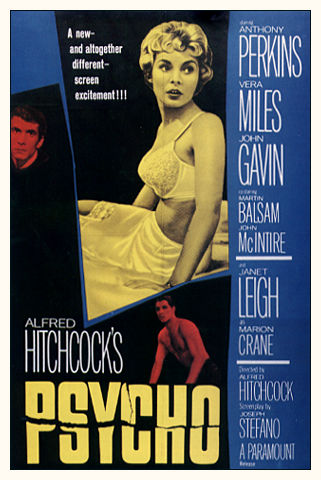 Horror films have a way of working themselves into their audiences' moviegoing lives. And despite the current laughable state of the genre, at some point in our lives, we've all shuddered during moments of terror, let out screams as a killer plots his next move against unsuspecting victims. And then there's the calling card of horror - the slasher sequence. Who among us can claim never to have hidden their eyes during such a scene? And as people who've experienced these noted side effects of the genre, we owe a debt to Alfred Hitchcock's 1960 genre-definer, Psycho.


